Meta Description: We are the manufacturer. What does a shock absorber do? It’s not just for comfort. Discover the critical functions of shock absorbers in controlling vehicle dynamics, ensuring tire contact, and providing safe braking and cornering.
Introduction
In the public consciousness, the shock absorber is often misunderstood and largely underestimated. It is frequently—and incorrectly—perceived as the component responsible for making a car’s ride soft. Ask any driver on the street what a shock absorber does, and you’ll likely get an answer about smoothing out bumps. While a byproduct of its function is indeed a more comfortable ride, to define it solely by this role is to ignore its true, engineering-critical purpose. From our position on the factory floor, where every component is engineered to precise specifications and subjected to rigorous testing, we can unequivocally state that the shock absorber is one of the most vital, and most misunderstood, safety systems in your vehicle.
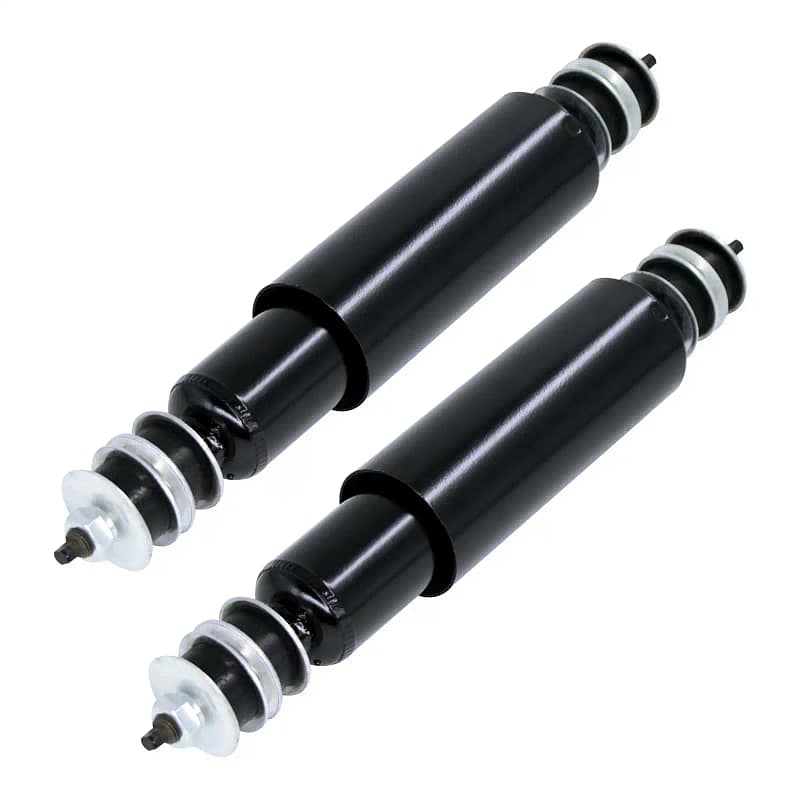
So, what does a shock absorber do, really? At its core, a shock absorber is a precision-tuned, hydraulic motion control device. Its fundamental job is not to absorb shocks—that task belongs to the springs—but to control the spring’s movement. A spring, by its very nature, stores energy when compressed and seeks to release it by pushing back. Without a controlling force, this stored energy would cause the vehicle to oscillate uncontrollably, bouncing wildly down the road. The shock absorber acts as this controlling force. It transforms the spring’s violent, uncontrolled energy into heat, which is then dissipated into the atmosphere, ensuring the wheel maintains consistent, predictable, and solid contact with the road surface.
This seemingly simple function has profound implications for every aspect of a vehicle’s performance. It governs stability under braking, the ability to navigate corners safely, and the overall predictability of the vehicle in emergency maneuvers. It is the unsung hero that allows the tires to do their job: gripping the road. This article is your definitive guide to the true function of the shock absorber. We will dismantle the common myths and explore the intricate science behind its operation, detailing precisely how this single component upholds the integrity of your car’s handling, steering, and, most importantly, safety.
Core Content
Section 1: Deconstructing the Myth: What a Shock Absorber is NOT
To understand what a shock absorber does, we must first clarify what it doesn’t. The single biggest misconception in the automotive world is that shocks are responsible for a soft or hard ride. This belief is so pervasive that it has led consumers to mistakenly request “stiffer shocks” for a sportier feel, often installing the wrong components for their vehicle and compromising its safety.
1. The Spring is the True Ride Component
The component responsible for a vehicle’s ride quality—its height and its ability to absorb the initial impact of a road bump—is the coil or leaf spring. The spring is designed to handle the weight of the vehicle and absorb large, low-frequency bumps, flexing to absorb the impact energy. If you were to remove your vehicle’s shock absorbers and leave only the springs, the car would be able to drive, but it would be nearly uncontrollable. The ride would not be “sporty” or “firm”; it would be dangerously bouncy.
2. The Shock is the Control Mechanism
The shock absorber works in direct conjunction with the spring. When the wheel hits a bump and the spring compresses, the shock absorber immediately begins to work. It uses a piston and valving system to slow down and meter the speed of this compression. As the spring unrolls (rebounds), the shock absorber applies resistance to that motion as well. It does this to prevent the spring from overshooting and launching the vehicle upward. In essence, the shock absorber’s job is to dampen the spring’s oscillation, ensuring that it compresses and rebounds at a controlled rate. A firm shock absorber simply provides more damping force, allowing the spring to do its job without excessive body movement, leading to a “controlled firm” ride, not a bone-jarring one. A faulty shock, conversely, allows the spring to move too freely, creating that uncomfortable, unsafe floating feeling.
Section 2: The Core Functions – Understanding the Motion Control Paradigm
Now that we have dispelled the primary myth, we can explore the true, multifaceted functions of a shock absorber. Far from being a simple comfort device, it is a critical regulator of vehicle dynamics.
1. Maintaining Tire-to-Road Contact: The Paramount Function
This is, without a doubt, the single most important job of a shock absorber. The performance of a vehicle’s safety systems—braking, acceleration, and cornering—is entirely dependent on the four patches of rubber where the tires meet the road. This is the vehicle’s only connection to the world. A shock absorber’s primary mission is to maximize the time and pressure that these tire contact patches remain on the road surface.
- The Science of Oscillation: Every time a wheel travels over a bump or a dip in the road, the wheel assembly moves up and down. The spring compresses to absorb the impact, and then it rebounds. Without the damping force of a shock absorber, this rebound would cause the wheel to lift off the pavement.
- The Consequence of Lift: When a wheel is in the air, it provides zero control. It cannot steer, it cannot accelerate, and it cannot brake. For that fraction of a second, you have lost a quarter of your vehicle’s traction and control. A vehicle with worn-out shock absorbers will experience this “wheel hop” repeatedly, especially on uneven surfaces. The result is a loss of stability, unpredictable handling, and dramatically increased braking distances, as the brake system has to wait for the wheel to return to the ground before it can apply full stopping power. A high-quality shock absorber ensures the wheel stays planted, glued to the pavement, allowing your tires to do their job effectively and continuously.
2. Ensuring Vehicle Stability and Body Control
Beyond the microscopic level of tire contact, a shock absorber controls the movement of the entire chassis of the vehicle. It manages the weight transfer that occurs during dynamic driving, keeping the car stable and composed.
- Braking: When you apply the brakes, weight shifts dramatically forward. A healthy shock absorber on the front axle controls how much this weight is transferred by dampening the initial dip of the front end. This prevents excessive “nose-dive,” maintaining a more stable attitude on all four wheels and helping prevent the rear of the car from becoming light and unstable.
- Acceleration: Under acceleration, weight transfers to the rear. Worn rear shocks can cause the rear of the vehicle to squat excessively, unsettling the front end and reducing the steering feel and initial bite of the front tires.
- Cornering: When turning, a vehicle’s body rolls towards the outside of the corner. Worn shocks allow this body roll to become exaggerated. The vehicle will feel “tippy,” and the suspension geometry can change, leading to a loss of grip. High-performance shocks with stiffer valving are designed to minimize this roll, keeping the vehicle flatter and more neutral, which allows for faster, more predictable cornering.
- The Crosswind and Rumble Strip Test: One of the best ways to feel the effect of your shock absorbers is on a freeway rumble strip or in a strong crosswind. A car with good shocks will track straight and resist being pushed around. A car with bad shocks will feel like it’s “wandering” or being “bobble-headed” by the strips and will be more susceptible to being pushed sideways by the wind, as it lacks the weight control to maintain a stable track.
Section 3: Advanced Functions – The Role in Modern Active Safety Systems
In the modern automotive era, the role of the shock absorber has evolved even further. It is no longer a purely passive component but has become an integral part of the vehicle’s advanced electronic safety suite.
1. The Foundation of Electronic Stability Control (ESC)
ESC, and its predecessors like Anti-lock Braking Systems (ABS), operate on a single principle: the need for traction. These systems use wheel speed sensors to detect when a wheel is about to lose grip or when the car is starting to skid. For these systems to work effectively, they need the wheels to be on the ground and rotating at speeds that can be accurately measured.
- How Shocks Enable ESC: A vehicle with worn shock absorbers will experience the wheel lift and skidding that we discussed earlier. When this happens, the ABS and ESC systems become confused. If a wheel is bouncing, it sends erratic speed data to the car’s computer, making it impossible for the system to intervene correctly. By keeping the tires firmly planted on the road, properly functioning shock absorbers provide a stable platform. This ensures that when the ESC system detects an impending skid, it can apply the brakes to individual wheels with maximum effectiveness, correcting the vehicle’s trajectory and preventing a spin. In essence, you can’t have reliable electronic safety if the foundation—the tire contact patch—is constantly being compromised by bad shocks.
2. The Synergy with Electronic Damping Control (EDC) and Air Suspension
On many high-end and performance vehicles today, shock absorbers have been elevated from simple mechanical devices to sophisticated electromechanical systems. Cars equipped with Electronic Damping Control (EDC) feature shocks with adjustable valving that can be changed by the driver via a button (e.g., “Comfort,” “Sport”) or automatically by the vehicle’s computer. The computer inputs variables like steering angle, throttle position, and g-forces to instantly adjust the shock’s damping characteristics, providing the perfect balance of comfort and performance for any situation.
Air suspension systems take this a step further, with shock absorbers that are specifically tuned work in conjunction with airbags. These systems can adjust ride height on the fly, ensuring an optimal contact patch for handling and comfort. In both these advanced systems, the shock absorber is no longer a passive component but an active partner in managing the vehicle’s overall dynamic behavior, highlighting how central this technology is to modern performance and refinement.
Conclusion: A cornerstone of Vehicle Safety and Performance
To ask “what does a shock absorber do?” is to open the door to a deeper understanding of vehicle engineering. It is a far cry from the simple comfort device it is often mistaken for. The shock absorber is a critical motion control device, a silent guardian of vehicle stability. Its primary function is to manage the spring’s energy, ensuring that the tire maintains constant, optimal contact with the road. This single capability is the bedrock upon which safe braking, predictable cornering, and effective electronic safety systems are built.
From our vantage point as a manufacturer, we see the shock absorber not as an accessory, but as a fundamental component of a vehicle’s safety architecture. Its job is to make the invisible forces of motion—weight transfer, oscillation, and energy—visible only through their absence: in the form of a stable, controlled, and confident driving experience. The next time you drive, pay attention. Feel how your car reacts to bumps and corners. Consider the silent work happening within the suspension. Understanding the true role of the shock absorber is key to appreciating the complex engineering that keeps you safe on every journey.