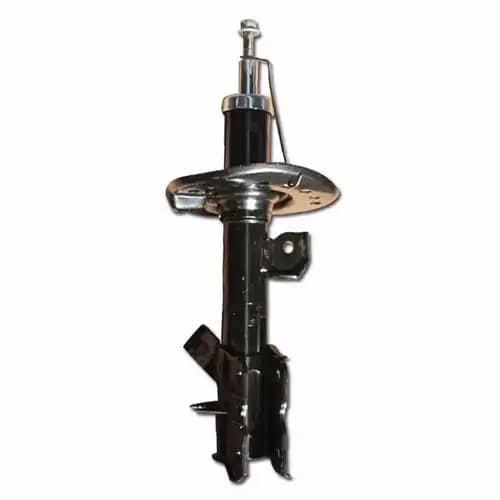
Meta Description: We are the manufacturer. Understanding the true shock absorber function is key to vehicle safety. Beyond ride comfort, learn how these critical components control springs, maintain tire contact, and ensure safe braking and handling. A definitive expert guide.
Introduction
In the intricate and symphony of automotive engineering, every component plays a vital role. From the roar of the engine to the precision of the steering, each part contributes to the overall performance and safety of a vehicle. Yet, one of the most crucial components often resides in the shadows of public understanding, its purpose misinterpreted. Most drivers believe the primary shock absorber function is to ensure a smooth, comfortable ride. While this is a noticeable and welcome benefit, it is not their fundamental purpose.
From our vantage point, on the factory floor where every component is engineered for a specific, critical task, we define the shock absorber function with absolute precision. A shock absorber is, in essence, a motion control device. Its primary job is not to “absorb” bumps—that task is beautifully handled by the suspension springs. Rather, its true function is to dampen the oscillations of the springs. A spring, by its very nature, is designed to compress and then release its stored energy, causing a rebound or bounce. Without a shock absorber to control this action, the vehicle would continue to bounce long after hitting a bump, leading to loss of control, unsafe handling, and a completely undrivable experience.
Therefore, the correct way to understand the shock absorber function is to see it as the essential governor that makes the entire suspension system safe, stable, and effective. This article delves deep into the core function of the shock absorber, exploring its vital role in maintaining tire-to-road contact, ensuring safe braking, controlling body roll, and protecting other vehicle components from premature wear. This is the definitive guide to the real purpose of shock absorbers, as seen by the engineers and manufacturers who build them.
Core Content
Section 1: Deconstructing the Misconception: Control vs. Absorption
To appreciate the true shock absorber function, we must first dismantle a common myth: its name itself. The term “shock absorber” is misleading because the component does not absorb the initial impact of a road irregularity. That energy is absorbed by the springs. Let’s break down the partnership between these two critical components.
1. The Spring: The First Line of Defense
The spring (be it a coil, leaf, or torsion bar) is the suspension’s compliant element. It is designed to compress, absorb, and store kinetic energy from bumps, potholes, and road seams. This action provides the initial cushioning that isolates the vehicle’s body from the roughness of the road. Without springs, every single imperfection would be directly transmitted to the chassis, creating an unbearably harsh and noisy ride.
2. The Shock Absorber: The Controller of Energy
Once the spring has absorbed the impact and compressed, it naturally wants to rebound, returning to its original shape. Here is where the shock absorber function becomes paramount. If the spring were to rebound unchecked and uncontrolled, it would do so with violent force, causing the wheel to lift off the pavement and the chassis to bounce uncontrollably.
The shock absorber’s core task is to provide resistance to this rebound. By precisely slowing down the spring’s movement, it ensures that the suspension extends smoothly and quickly enough to maintain contact with the road surface for the next surface imperfection. It acts as the brake for the spring. This is why a vehicle with completely worn-out shock absorbers will exhibit excessive and prolonged bouncing, also known as “porpoising.” This visual phenomenon perfectly illustrates what happens when the shock absorber function fails, leaving the spring to operate without a governor. Therefore, the function of a shock absorber is control, not absorption.
Section 2: The Paramount Safety Function: Ensuring Tire-to-Road Contact
If we could distill the single most important shock absorber function into one phrase, it would be: maintaining the tire’s contact patch with the road. The four small contact patches between your tires and the pavement are the only connection your vehicle has with the road surface. Every action of a vehicle—accelerating, braking, steering, and cornering—is entirely dependent on the friction generated at these four patches. The shock absorber is the unsung hero that ensures these patches remain firmly planted and effective.
1. The Foundation of Safe Braking
When you press the brake pedal, the vehicle’s weight shifts dramatically forward due to inertia. This weight transfer causes the front suspension to compress and the rear suspension to extend.
- With a Healthy Shock Absorber: The front shock controls the compression, preventing excessive “nose-dive.” This keeps the front tires firmly pressed against the road, allowing them to effectively translate braking force into deceleration. The rear shock controls the extension, preventing the rear of the car from squatting and potentially causing the rear tires to lose grip.
- With a Failed Shock Absorber: A worn front shock allows the front of the car to dip excessively. In a severe case, this can cause one or both front wheels to momentarily lift off the ground. A tire that is not in contact with the road cannot stop the car. This phenomenon dramatically increases stopping distances and compromises the efficiency of anti-lock brake systems (ABS).
The shock absorber function in braking is not about comfort; it is about control and maintaining a critical safety link to the road.
2. Managing Body Roll for Stable Cornering
When a vehicle navigates a corner, centrifugal force acts on the chassis, causing it to lean outward from the center of the turn. This is known as body roll.
- With a Healthy Shock Absorber: The shock absorbers work in concert with the anti-roll bar (sway bar) to control this lean. By resisting the chassis’s movement, they keep the vehicle flatter in the corner. This controlled roll is desirable as it can improve tire grip under certain conditions, but excessive roll is the enemy of stability.
- With a Failed Shock Absorber: Worn shocks offer little resistance to body roll. The vehicle leans excessively, causing the outside tires to bear most of the vehicle’s weight. This can lead to a loss of traction on the inside tires and a potential “rollover” feeling. Furthermore, extreme body roll can negatively affect the suspension’s geometry, causing the outside tires to splay outwards and reducing their effective contact patch.
The shock absorber function is therefore directly linked to predictable, confidence-inspiring handling, allowing a driver to navigate corners safely and with precision.
3. Enabling Predictable Emergency Maneuvers
The ultimate test of the shock absorber function occurs during an evasive maneuver, such as a sudden swerve to avoid an obstacle. In this high-stress situation, the driver inputs quick, sharp steering.
- With a Healthy Shock Absorber: The suspension moves quickly and predictably to absorb and control the weight shifts. The shock absorbers ensure that the vehicle remains stable and that the body doesn’t continue to rock or sway long after the steering input has been corrected. This stability allows the driver to maintain control and successfully complete the maneuver.
- With a Failed Shock Absorber: The vehicle feels “loose” or “wallowy.” After a quick turn, the chassis will continue to rock back and forth, fighting the driver’s attempts to keep the car on its intended path. This instability is a primary cause of loss of control during emergency situations.
Section 3: Ancillary but Essential Functions
Beyond its primary safety roles, the correct shock absorber function has several other significant benefits for the vehicle’s overall health and longevity.
1. Protection of Suspension Components
A vehicle with non-functional shock absorbers sends stress throughout the chassis. The uncontrolled bouncing and jouncing that results puts immense, unexpected strain on other suspension components. This leads to accelerated wear on critical parts such as:
- Control arm bushings
- Ball joints
- Tie rod ends
- Wheel bearings
By doing its job, the shock absorber protects these other components, extending their service life and reducing the total cost of vehicle ownership. This protective function is a key reason why all shocks, not just the worn ones, should be replaced in pairs.
2. Contribution to a Quiet and Smooth Ride
While secondary to its safety mission, the shock absorber function is intrinsically linked to comfort and Noise, Vibration, and Harshness (NVH). A shock absorber tuned for touring will have softer damping to absorb high-frequency road vibrations that would otherwise be transmitted into the cabin as noise and harshness. Furthermore, by eliminating the violent body roll and bouncing associated with worn shocks, a vehicle feels more solid, secure, and refined, contributing to a higher-quality driving experience. Stable suspension equals a stable, quiet, and comfortable cabin.
Section 4: The Evolution of the Shock Absorber Function
The basic principle of damping remains the same, but technology has evolved, allowing the shock absorber function to be more dynamic and intelligent.
- Passive Dampers: These are the traditional fixed-valve shocks found on the vast majority of vehicles. Their damping characteristics are set at the factory and do not change.
- Active/Adaptive Dampers: Found in modern luxury and performance vehicles, these are game-changers. Systems like Magnetic Ride Control use shock absorbers filled with a magneto-rheological fluid. An electromagnetic field can change the fluid’s viscosity in milliseconds, allowing the shock to instantly switch between a soft and a firm state. Other systems use computer-controlled solenoids to adjust oil flow through the valving.
- Function: The vehicle’s computer analyzes data from sensors (speed, steering angle, g-forces) and selects the optimal setting for the current conditions. This creates multiple personalities in one vehicle: comfort-focused on the highway, and razor-sharp on a winding road. This technology elevates the shock absorber function from a passive mechanical response to an active, predictive element of the chassis system.
Conclusion
To summarize, the shock absorber function is often misunderstood. It is far more than a ride comfort device. From our expert, factory-level perspective, its primary and most critical function is to control the movement of the vehicle’s springs. This single action has a cascade of beneficial effects, most importantly ensuring the tires maintain constant and unbroken contact with the road. This function is the absolute bedrock of vehicle safety, enabling predictable braking, stable cornering, and secure emergency handling. It also protects other vital components and contributes to a refined ride quality. The next time you think about your car’s shock absorbers, remember their role not as passive parts, but as active controllers of motion, working tirelessly to keep you safe and in command of your vehicle.