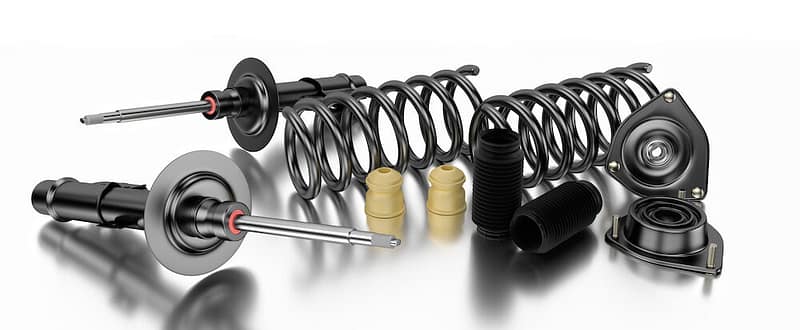
Meta Description: What is a shock absorber in a car? As the manufacturer, we provide the definitive answer. Go beyond basic definitions to understand its crucial function in motion control, safety, and vehicle performance. Learn about types, operation, and why it’s a critical safety component.
Introduction
The term “shock absorber” is widely recognized, but its true identity and significance are often misunderstood by the average driver. When asked, “what is a shock absorber in a car?” the immediate, and incorrect, answer is typically, “It’s the part that makes the ride smooth.” While ride quality is a direct beneficiary of its function, this perception only scratches the surface of the component’s complex engineering and critical importance. From our vantage point on the factory floor, where every component is subjected to thousands of hours of design validation and stress testing, we define a shock absorber not by its secondary effects, but by its core purpose.
So, truly, what is a shock absorber in a car? It is a sophisticated mechanical device designed as a damper for suspension springs. Its primary role is to absorb and dissipate the kinetic energy generated by the movement of the wheels and the suspension, converting it into heat. This controlled dissipation of energy is the foundation of vehicle stability, handling, and, most importantly, safety. It is the essential partner to the spring, preventing the spring’s natural tendency to oscillate uncontrollably. This article will move beyond simplistic analogies to provide a deep, authoritative understanding of what a shock absorber is, breaking down its function, anatomy, and the critical role it plays in the modern automobile.
Core Content
Section 1: The Fundamental Definition and Purpose: More Than Just a Smooth Ride
To begin our exploration, we must establish a clear and accurate definition. What is a shock absorber in a car? Put simply, it is a velocity-sensitive hydraulic damping device. This definition contains three crucial keywords: “velocity-sensitive,” “hydraulic,” and “damping.”
- Damping: This is the core function. Damping is the process of controlling motion or oscillation through the application of a resistive force. In this case, it is the resistance to the rapid up-and-down movement of a wheel.
- Hydraulic: This describes the primary mechanism. Most shock absorbers use an incompressible fluid (hydraulic oil) to create this resistance. As the shock moves, it forces fluid through precisely calibrated valves, creating the damping effect.
- Velocity-Sensitive: This describes the intelligent nature of its operation. The amount of resistance provided by the shock absorber is not constant; it changes based on the speed of the piston movement. Faster movements (like hitting a large pothole or aggressive cornering) generate higher pressure, forcing the oil through smaller orifices for greater resistance. Slower movements encounter less resistance. This adaptive characteristic is what allows the shock to balance comfort and performance.
A common and effective analogy is comparing a shock absorber to an oil syringe. When you slowly push the plunger, it moves easily. When you push it forcefully and quickly, it becomes much harder to move due to the resistance created by the fluid trying to escape through the tiny gap between the plunger and the barrel. This basic principle is amplified with complex valving to create the sophisticated control system found in modern cars.
The primary job of a shock absorber, therefore, is to control the transient energy of the suspension. A spring stores energy; a shock absorber manages its release. Without a functioning shock absorber, the suspension would oscillate uncontrollably after even a minor bump, making the vehicle unstable and undrivable.
Section 2: Anatomy of a Modern Shock Absorber: The Key Components
To fully grasp what a shock absorber is, one must understand its internal architecture. A vehicle’s shock absorber is a precisely engineered assembly of multiple high-quality components working in harmony. Let’s break down the anatomy of a typical hydraulic shock absorber, focusing on the most common twin-tube design.
1. Outer Cylinder (Reservoir Tube): This is the main body of the shock absorber, typically constructed of seamless, cold-drawn steel. In a twin-tube design, this outer cylinder serves as a reservoir for the bulk of the hydraulic fluid and, in gas-charged models, houses the pressurized nitrogen gas.
2. Inner Cylinder (Pressure Tube): Mounted concentrically within the outer cylinder, the pressure tube is where the primary action occurs. The piston and piston rod move through this inner tube, which is precision-machined to a smooth finish to minimize friction and wear.
3. Piston Rod: The piston rod is a large-diameter, highly polished and hardened steel rod that transmits force between the vehicle’s chassis (or body) and the shock’s internal assembly. It is sealed as it exits the main body by a rod guide and seals. Its rigidity and surface finish are critical to preventing leakage and stiction (stick-slip friction).
4. Piston Assembly: This is the “brain” of the shock absorber. The piston is securely attached to the piston rod. It features multiple precisely machined orifices and slots, which house a complex system of shims, washers, and spring-loaded valves. These valves—both compression and rebound—are calibrated to provide specific damping characteristics.
5. Valving System: As previously mentioned, the valving is what makes a shock absorber “velocity-sensitive.”
- Compression Valves: These control the flow of fluid as the piston moves down the tube (when the wheel hits a bump). The valving is typically designed to be relatively soft to allow for a comfortable ride over smaller road irregularities.
- Rebound Valves: These control the flow of fluid as the piston moves back up the tube (as the spring pushes the wheel back down). Rebound damping is always significantly firmer than compression damping. This is critical to prevent the suspension from “rebounding” too quickly and causing the wheel to lift off the road, which would lead to a catastrophic loss of control.
6. Base Valve (in Twin-Tube Designs): Located at the bottom of the pressure tube, the base valve is a one-way valve that allows fluid to be displaced from the pressure tube into the outer reservoir during the compression stroke. It also contains a set of precise valving that works in concert with the piston’s valving to fine-tune the overall damping performance.
7. Seals and Bump Stops: High-performance elastomeric seals are used to keep the hydraulic fluid contained within the pressure tube and contaminants (like dirt and road salt) out. They are engineered for durability and low friction. A bump stop is a polyurethane block at the bottom of the shock that provides a solid “bottom-out” cushion, preventing the metal components from crashing together under extreme compression, thereby preventing damage.
Understanding this internal anatomy reveals that a shock absorber is not a simple device but a complex, precision-engineered system built from specialized materials and designed to operate under extreme conditions.
Section 3: Different Types of Shock Absorbers: Evolution of Design
The fundamental principle of damping remains constant, but shock absorber technology has evolved significantly. When answering the question, what is a shock absorber in a car today?, we must consider the different types.
1. Twin-Tube Shock Absorbers:
- What it is: The most common and affordable type, as described above. It has a single pressure tube inside a larger outer reservoir tube.
- Function: Simpler construction, adequate for most standard passenger vehicles. Performance can be limited by “foam” or “aeration,” where fluid mixes with air during high-frequency operation, leading to a loss of damping efficiency. Gas-charging helps mitigate this.
2. Monotube Shock Absorbers:
- What it is: A high-performance design featuring a single, pressurized tube. The piston rod moves through the center, separating the shock oil from a high-pressure (250-300+ psi) charge of nitrogen gas.
- Function: The high-pressure charge prevents aeration and “foaming,” providing consistent damping performance even under demanding conditions. The monotube design is more efficient at dissipating heat and allows for the use of a larger piston for a given diameter, resulting in more precise and higher damping forces. These are standard on most sports cars, trucks, and SUVs used for towing or off-road activities.
3. Adaptive/Smart Shock Absorbers:
- What it is: The pinnacle of shock absorber technology. These are electronically controlled shocks equipped with sensors and an internal valve mechanism that can be adjusted in real-time.
- Function: Systems like Magnetic Ride Control (MRC) use a fluid containing tiny, iron particles. By applying an electric current to a coil around the shock, an electromagnetic field changes the alignment of these particles, instantly altering the fluid’s viscosity and thus its damping capability. Other systems use computer-controlled solenoids to meter oil flow. This allows the car’s ECU to select from multiple damping maps, providing a seamless transition from a comfortable, compliant ride in “Comfort” mode to a firm, body-roll-free “Sport” mode. This technology integrates the shock absorber directly into the vehicle’s overall dynamics control system.
Section 4: The Consequences of Failure: Why Knowing What a Shock Absorber Is Matters
Understanding what a shock absorber in a car is for becomes critically important when it begins to fail. A worn-out shock absorber is a significant safety hazard. The consequences of a failed damping function include:
- Increased Braking Distance: As mentioned, worn shocks allow the tire to lift off the road during hard braking, directly increasing the distance required to stop.
- Poor Handling and Body Roll: The car will feel unstable, leaning excessively in corners and wallowing through lane changes.
- Hydroplaning: A shock’s role of keeping the tire pressed down becomes vital in wet conditions. Worn shocks can contribute to a loss of traction in standing water.
- Premature Tire Wear: If the tire is bouncing instead of staying planted, it will not wear evenly, leading to scalloping or cupping, which shortens tire life.
- Excessive Suspension and Brake Wear: Uncontrolled suspension movement puts immense stress on other components like ball joints, bushings, and tie rods.
Conclusion
So, returning to our core question: what is a shock absorber in a car? It is far more than a passive component. It is an active, velocity-sensitive, safety-critical machine. It is the master of kinetic energy, using the precise flow of hydraulic fluid through complex valving to control the oscillations of the springs. This control is the very essence of vehicle stability, directly translating to shorter braking distances, predictable handling, and a secure, confidence-inspiring drive. From the robust twin-tube to the advanced smart shock, its function is fundamental to performance and safety. Recognizing its true nature allows every driver to appreciate its essential role and understand the importance of regular inspection and maintenance.