Meta Description: What does a shock absorber do? As a manufacturer, we explain its primary function to control spring motion, ensuring tire contact, safety, and vehicle stability. Learn how it works, its impact on handling, and its role as a critical safety component.
Introduction
Every time a driver confidently navigates a winding road, safely steers clear of an unexpected pothole, or comes to a smooth, controlled stop, they are relying on a set of components that operate largely unseen. One of the most misunderstood parts of this system is the shock absorber. When asked a fundamental question like, “what does a shock absorber do?” the answer is often mischaracterized as simple ride comfort. From our vantage point on the factory floor, where every component is engineered and tested for thousands of cycles, we must correct this profound misconception.
The simple truth is that while a ride quality benefit exists, the primary function of a shock absorber is not to make a car “soft.” To understand what does a shock absorber do, one must first understand what it doesn’t do. It is not a spring. It does not support the vehicle’s weight. Instead, its singular, critical purpose is to control the motion of the springs. It acts as the powerful, intelligent damping force that prevents the springs from continuing to bounce uncontrollably. This ability to regulate suspension oscillations is the key to vehicle safety and stability. This article will provide a definitive, manufacturer-level explanation of what does a shock absorber do, breaking down its functions, its importance, and its vital role as a cornerstone of a vehicle’s handling and safety systems.
Core Content
Section 1: The Primary Function: Controlling Spring Oscillations
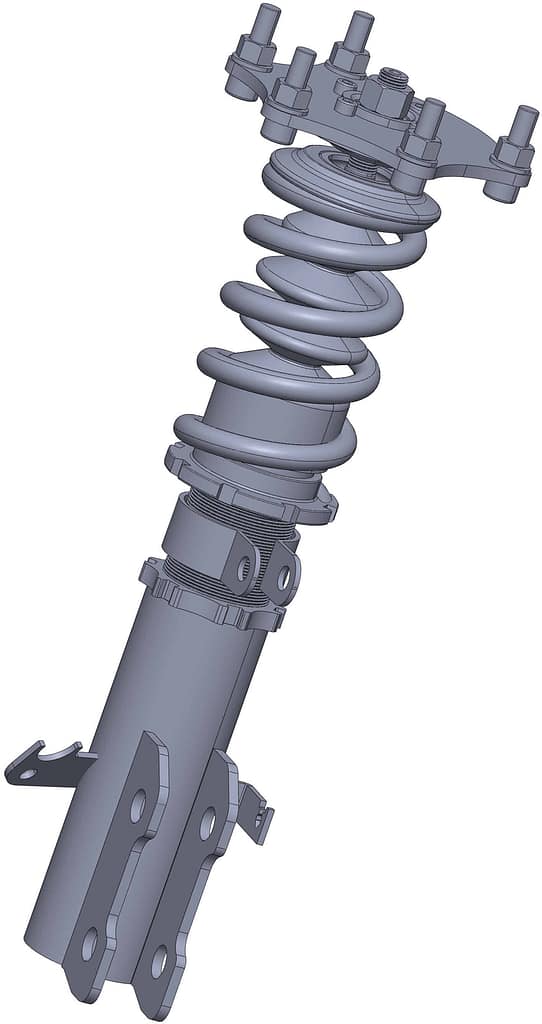
To truly grasp what does a shock absorber do, we must first understand its partnership with the spring. The spring (whether it’s a coil or leaf spring) is the component that physically supports the vehicle’s weight and absorbs the initial energy from a road irregularity. When a wheel hits a bump, the spring compresses, storing kinetic energy like a loaded spring. The problem is that a spring, once released, will naturally rebound to its original length and overshoot, causing the wheel to lift off the road and the vehicle to bounce.
This is where the shock absorber’s function becomes essential. What does a shock absorber do in this scenario? It applies a precise, velocity-controlled resistance to the spring’s extension. It forces the spring to return to its neutral position smoothly, slowly, and firmly. It essentially acts as a “brake” for the spring, preventing it from oscillating.
- Compression Stroke: When a wheel hits a bump, the suspension is compressed, pushing the shock absorber piston inwards. The shock’s valving opens to let hydraulic fluid pass, providing enough give for the spring to absorb the initial impact.
- Rebound Stroke: After the initial compression, the spring pushes back to extend the suspension. This is when the shock absorber’s function is most critical. The shock’s rebound valves snap shut, providing significant resistance. This firm, controlled rebound is what keeps the tire pressed against the pavement and prevents the “bouncy” feeling that would occur without a damper.
Therefore, the core function of what does a shock absorber do is to dampen the energy from the spring, transforming an uncontrolled, bouncing motion into a single, controlled, and stable one. Without this damping function, a car would be virtually undrivable, oscillating wildly after every minor bump.
Section 2: The Safety Imperative: Ensuring Tire-to-Road Contact
While controlling spring motion is the technical function, the ultimate purpose of this control is safety. What does a shock absorber do to protect the driver and vehicle? Its most critical safety function is to maintain the tire’s constant and unwavering contact with the road surface. The four small patches where the tires meet the pavement are the vehicle’s only connection to the world. Every aspect of vehicle control—accelerating, braking, steering—depends entirely on the friction generated at these four contact patches. A shock absorber’s job is to keep the tires firmly planted.
- What does a shock absorber do during emergency braking? When a driver slams on the brakes, the vehicle’s weight violently shifts forward. This compresses the front suspension and unloads the rear. A healthy front shock absorber controls this weight transfer, preventing dangerous “nose-dive” and ensuring the front tires remain firmly on the ground to apply maximum stopping force. A worn front shock allows the front end to lunge forward, potentially causing the front tires to lock or, in extreme cases, lift off the ground, and it unloads the rear, which can lead to loss of directional control.
- What does a shock absorber do during cornering? When navigating a corner, the vehicle’s weight shifts to the outside wheels due to centrifugal force, causing the car to “roll.” A properly functioning shock absorber resists this roll, keeping the vehicle as flat as possible. This stability is crucial for maintaining grip. If shocks are weak, excessive body roll can cause the inside tires to lift, drastically reducing the vehicle’s ability to corner and potentially leading to a rollover. This controlled body roll is a hallmark of a well-handling vehicle and is a direct result of the shock absorber’s ability to dampen chassis movement.
- What does a shock absorber do on wet roads? In wet conditions, a tire needs to be pressed down firmly to channel water out from beneath it to prevent hydroplaning. A shock absorber that cannot control suspension movement allows the tire to dance or skip on the water’s surface, instantly severing the vital connection between the tire and the road. The uncontrolled motion can cause a loss of traction, which can be catastrophic at speed.
In summary, the answer to what does a shock absorber do in terms of safety is simple and unequivocal: it is a device that maintains tire contact. Any situation where a tire loses contact with the road is a life-threatening event, and the shock absorber is the primary component engineered to prevent this.
Section 3: Enhancing Control and Performance: Beyond Safety
Safety is paramount, but the functions of a shock absorber extend directly to enhancing the overall driving experience and vehicle performance.
- What does a shock absorber do to improve ride quality? By controlling high-frequency vibrations and eliminating the jarring, “crashy” feeling of a suspension with only springs, a good shock absorber contributes to a smooth, isolated, and comfortable ride. It ensures that only the larger, gentler motions of the suspension are transmitted to the cabin, filtering out the harshness of the road surface. This is often the most noticeable benefit to the average driver.
- What does a shock absorber do for handling? A vehicle’s handling is directly related to how its chassis moves. A well-damped car feels solid, planted, and responsive. It responds precisely to steering inputs, accelerates and brakes without wallowing or squatting, and feels “stuck” to the road. This feeling of control and predictability is a direct result of the shock absorber’s ability to manage suspension motion and keep the tires under control. In performance vehicles, this is taken to an extreme, with stiffer shocks used to keep the car flat during high-G cornering.
- What does a shock absorber do to protect other components? Every uncontrolled suspension movement puts stress on the rest of the vehicle’s chassis. By containing these motions, a healthy shock absorber prevents wear and tear on other critical components, including the control arm bushings, ball joints, tie rod ends, and wheel bearings. This protective function helps maintain the vehicle’s structural integrity and extends its overall lifespan, providing better long-term value for the owner.
Section 4: The Technology of Damping: Mono-Tube, Twin-Tube, and Adaptive Systems
The principle of what does a shock absorber do remains consistent, but the technology has evolved to adapt to different demands. Understanding the different types helps explain how this function can be optimized for various applications.
- Twin-Tube Shock Absorbers: This is the most common design, especially in standard passenger vehicles. It consists of an outer tube (which acts as a fluid reservoir) and an inner tube where the piston operates. They are cost-effective and provide a comfortable ride. A limitation can be aeration, where the fluid mixes with air during heavy use, causing a temporary loss of damping performance.
- Mono-Tube Shock Absorbers: Favored in performance and heavy-duty applications, a mono-tube shock is a single, larger tube that is pressurized with high-pressure nitrogen. This design provides superior heat dissipation and is completely immune to aeration, leading to more consistent and fade-free performance. This allows the shock absorber to perform its damping function perfectly even under the most demanding conditions.
- Adaptive/Semi-Active Shock Absorbers: These are the ultimate expression of damping technology. Systems like Magnetic Ride Control use a shock absorber filled with a specialized magneto-rheological fluid. This fluid contains tiny magnetic particles. By applying an electrical current through a coil around the shock body, the viscosity of the fluid can be changed in milliseconds. What does a shock absorber do when it’s adaptive? It adapts. One moment it can be soft and comfortable, the next it can be rock-solid for sporty handling, all automatically based on the car’s computer reading the driving conditions. It takes a static function and makes it dynamic, allowing the vehicle to be two different cars at the touch of a button.
Section 5: The Signs of a Failing Shock Absorber
Knowing what does a shock absorber do is only half the battle. A driver must also recognize the signs that it is no longer performing its functions. A failing shock absorber often degrades gradually, making it easy to overlook the dangers.
Key indicators of a worn-out shock absorber include:
- The car “bounces” more than once or twice after hitting a bump.
- The front end dives significantly when braking.
- The rear end squats excessively when accelerating.
- The vehicle leans or rolls excessively in turns.
- A bouncy or “wallowy” ride, especially on highways.
- Uneven or cupped tire wear patterns.
- A general feeling of instability or being “floaty.”
When these signs appear, it is critical to have the shock absorbers inspected by a professional. As a safety-critical component, their replacement should not be delayed.
Conclusion
In conclusion, the answer to what does a shock absorber do is multifaceted and critical. Its primary and most important function is to control the motion of the suspension springs. By doing so, it serves as the guardian of safety, ensuring the tires maintain constant contact with the road. This single function is the foundation for effective braking, stable cornering, and predictable handling, making it a non-negotiable aspect of vehicle safety. Beyond safety, its function extends to enhancing ride quality, protecting other vehicle components, and enabling performance. Understanding the true role of the shock absorber—far beyond a simple comfort device—is key to appreciating the sophisticated engineering that goes into making every drive safe and controlled.