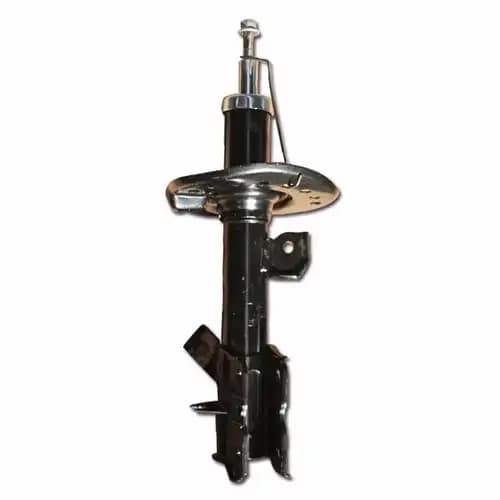
Meta Description: What do shock absorbers do? As a manufacturer, we provide the definitive answer: they control spring motion to ensure tire contact, guaranteeing vehicle safety, stability, and control. Learn the true function here.
Introduction
In the intricate world of automotive engineering, few components are as frequently misunderstood as the shock absorber. When posed with the question, “What do shock absorbers do,” the most common answer is, “They make the ride smooth.” While this is an observable and appreciated result, from our perspective on the factory floor—where every component is forged and tested under rigorous, real-world conditions—we must correct this fundamental misconception. To truly define what do shock absorbers do requires a shift in perspective away from comfort and toward safety. A shock absorber is not a ride comfort device; it is a velocity-sensitive damping system and a critical safety component.
Its primary function is not to absorb the impact of a bump—that is the exclusive role of the spring. Instead, its purpose is to manage the kinetic energy created by the spring after it has absorbed the shock. Think of it this way: without a shock absorber, a car’s suspension would bounce uncontrollably after every single bump. The shock absorber’s job is to control this rebound, ensuring the spring returns to its neutral position smoothly and without oscillation. This one function is the bedrock of vehicle stability and tire control, which are the absolute cornerstones of safe driving. This article, written from our vantage as a manufacturer, will dismantle the myths and provide a professional, authoritative explanation of what do shock absorbers do, clarifying their indispensable role in the modern automobile.
Core Content
Section 1: Deconstructing the Misconception: Shock Absorbers Don’t Absorb Shocks
To answer the question, what do shock absorbers do, we must first address the historical misnomer inherent in their name. They do not “absorb shocks.” The initial impact from a road irregularity is handled by the spring—a coil, leaf, or torsion spring. The spring’s job is to flex, compress, and store the energy of the impact, providing the primary level of cushioning that isolates the chassis from the roughness. If a car were equipped with springs alone, every time a wheel hit a bump, the spring would rebound, forcefully lifting the wheel off the road and causing the vehicle to bounce multiple times until the energy was dissipated. This chaotic, uncontrolled motion would render the vehicle virtually undrivable and exceptionally dangerous.
This is the precise moment the shock absorber’s role becomes essential. What do shock absorbers do in this scenario? They apply a precisely calibrated, velocity-controlled resistance to the spring’s rebound. They act as a powerful, intelligent brake for the suspension, forcing the spring to return to its ready state for the next bump, rather than allowing it to oscillate freely. They control the motion, not the impact. This distinction is the most critical piece of information when trying to understand what do shock absorbers do. It refocuses their function from a simple comfort feature to a complex motion-control system that is fundamental to vehicle dynamics.
Section 2: The Core Function: Tire Contact and Vehicle Safety
The ultimate purpose of controlling suspension motion—what do shock absorbers do in a practical sense—is to ensure the vehicle’s tires maintain constant and uninterrupted contact with the road surface. The four small, square-shaped patches where your tires meet the pavement are the only connection your vehicle has with the physical world. Every maneuver you perform—braking, accelerating, steering, or swerving—relies entirely on the friction generated at these four contact patches.
- What Do Shock Absorbers Do During Braking? When you press the brake pedal, inertia causes the vehicle’s weight to violently shift forward. This is known as weight transfer. The front suspension compresses under this load, while the rear extends. A properly functioning front shock absorber actively resists this forward dive. This keeps the front tires firmly planted on the road, ensuring maximum braking force and stability. In a vehicle with worn shocks, the front end can dip so aggressively that it potentially unloads a front wheel, causing a loss of braking capability and initiating a skid.
- What Do Shock Absorbers Do During Cornering? When navigating a turn, centrifugal force pushes the vehicle’s weight to the outside, causing the body to lean or “roll.” The shock absorbers work in concert with the anti-roll bar to dampen this motion. By providing resistance, they keep the vehicle as flat as possible, ensuring that all four tires contribute to cornering grip. With weak shocks, excessive body roll can cause the inside tires to lose contact with the road, drastically reducing the vehicle’s stability and turning capability and increasing the risk of a rollover.
- What Do Shock Absorbers Do on Uneven Surfaces? On a gravel road or a bumpy surface, a shock absorber rapidly controls the up-and-down movement of each wheel independently. This continuous control ensures that each tire maintains traction, allowing the driver to maintain steering and throttle input. Without a shock absorber, the wheels would hop and skip uncontrollably, leading to a complete loss of control.
Therefore, the primary and most important answer to what do shock absorbers do is: they maintain tire contact. This is not a feature; it is a fundamental requirement for vehicle safety.
Section 3: The Impact on Performance, Handling, and Component Longevity
While safety is paramount, the influence of shock absorbers extends into other critical areas of vehicle performance and longevity.
- Enhanced Handling and Stability: A car with healthy shock absorbers feels solid, predictable, and responsive. It turns precisely into a corner without excessive body roll, accelerates without squatting excessively at the rear, and brakes in a straight line without nosediving. This feeling of connectedness and control is a direct result of controlled suspension motion. A vehicle with worn shocks feels “floaty” or “boat-like,” its movements feeling large, slow, and disconnected from the driver’s inputs.
- Improved Ride Refinement: A shock absorber contributes to a smooth ride not by softening bumps, but by eliminating the high-frequency vibrations and secondary bounces that would otherwise be transmitted into the cabin. A worn shock allows the suspension to “chatter,” creating a jarring and uncomfortable ride. By managing the spring’s energy smoothly, the shock absorber refines the overall ride quality, demonstrating that the function of what do shock absorbers do in terms of comfort is one of refinement, not softness.
- Protection of Other Vehicle Components: Every uncontrolled suspension movement translates into stress and vibration that is transferred throughout the vehicle’s chassis. A functioning shock absorber dampens these motions, protecting other critical parts like the control arm bushings, ball joints, tie rod ends, and even the springs themselves from premature wear and fatigue. This “protection” role is a key part of the system’s integrity, ensuring the longevity and reliability of the entire vehicle. When shocks fail, they create a ripple effect of stress that can lead to costly repairs elsewhere.
Section 4: The Engineering of Damping: Mono-Tube and Twin-Tube Designs
To fully appreciate what do shock absorbers do, it’s helpful to understand the underlying technology. From our factory, we engineer different designs to meet the specific performance targets of various vehicles.
- Twin-Tube Shock Absorbers: This is the most prevalent design in standard passenger cars. It consists of two cylinders: a larger outer tube that acts as a fluid reservoir and a smaller inner tube where the main piston assembly moves. They are cost-effective and offer a good balance between ride comfort and performance. Their primary limitation is susceptibility to “aeration,” where the hydraulic fluid mixes with air under harsh, sustained use, which can temporarily diminish damping performance.
- Monotube Shock Absorbers: This high-performance design is found in sports cars, heavy-duty trucks, and performance-oriented SUVs. It consists of a single, large tube that is pressurized with high-pressure nitrogen (300+ psi). A floating piston separates the hydraulic oil from the nitrogen gas. This design offers superior heat dissipation and is immune to fluid aeration, leading to more consistent and fade-free performance. It can manage higher damping forces, making it ideal for demanding applications where stability is paramount.
- Adaptive/Semi-Active Systems: This is the zenith of shock absorber technology. Systems like Magnetic Ride Control use a shock absorber filled with a magneto-rheological fluid—a fluid containing magnetic particles. By applying an electrical current to a coil around the shock body, the viscosity of the fluid can be altered in milliseconds. What do shock absorbers do in an adaptive system? They adapt. The car’s computer analyzes real-time data from sensors—steering angle, yaw rate, road conditions—and automatically selects the optimal damping setting, transitioning from a plush, comfortable ride to a firm, sporty one instantly. This dynamic adjustment maximizes both comfort and handling on demand.
Section 5: Recognizing the Failure and Understanding Replacement
A driver must also know the signs when a shock absorber is no longer able to perform its function. The degradation is often gradual, making it easy to become accustomed to poor handling.
Key indicators of a failing shock absorber include:
- The vehicle bounces more than once or twice after a bump.
- Excessive front-end dive during braking or rear-end squat during acceleration.
- Noticeable body lean or roll during cornering.
- A bouncy, unstable feeling on the highway.
- Uneven or “cupped” tire wear.
- Visible leakage of hydraulic fluid.
When these symptoms appear, the shock absorber should be inspected by a qualified professional. As a critical safety system, it is not a part to be ignored. For optimal safety and balanced handling, it is standard practice to replace shock absorbers in pairs or, ideally, all four at the same time.
Conclusion
In final answer to the question, what do shock absorbers do, we can state with manufacturer-level clarity: they are a critical safety component whose primary function is to control the motion of the suspension springs. By damping the kinetic energy of the springs, they ensure the tires remain in constant contact with the road surface. This single function is the foundation of vehicle safety, enabling effective braking, stable cornering, and predictable control. While they contribute to a refined ride quality, their true and most vital role is as the guardian of stability. Understanding what do shock absorbers do reveals them to be far more than just a comfort device; they are an essential element of the vehicle’s safety and dynamic performance system.