Meta Description: Shock absorber vs suspension: what’s the difference? As a leading manufacturer, we clarify this critical distinction. The suspension is the entire system, while the shock absorber is one vital component. Learn how they work together for safety and performance.
Introduction
In the lexicon of vehicle maintenance and performance, few terms are more commonly misunderstood and interchangeable than “shock absorber” and “suspension.” A customer might say, “I need to fix my car’s suspension,” after hitting a particularly large pothole, or a mechanic might diagnose a “bad suspension” when in reality, only the shock absorber is the culprit. This confusion is not just a matter of semantics; it represents a fundamental misunderstanding of how a vehicle’s chassis and wheels interact with the road. As a manufacturer dedicated to precision engineering, we see this confusion as an opportunity to provide clarity. The relationship between a shock absorber and suspension is not one of competition but of critical interdependence—one is the system, the other is a key component within it. This definitive guide will peel back the layers of confusion, providing a clear, expert comparison of shock absorber vs suspension, explaining their individual functions, their symbiotic relationship, and why understanding the difference is paramount for vehicle safety, performance, and longevity.
Core Content
Section 1: Defining the Contenders: Understanding the Scope of Each Term
To effectively compare a shock absorber vs suspension, we must first establish a precise definition for each term. The core difference lies in their scope: one is the entire system, and the other is a single, albeit vital, part of that system.
A. What is the Suspension System?
The suspension system is an intricate, interconnected assembly of components whose primary purpose is to provide a comfortable ride while maintaining consistent road contact for optimal vehicle control. It is the bridge between the vehicle’s chassis (the frame and body) and its wheels. As a comprehensive system, the suspension performs several key functions simultaneously:
- Support Vehicle Weight: It bears the weight of the vehicle, engine, passengers, and cargo.
- Absorb Road Impacts: It isolates the chassis from irregularities in the road surface, such as bumps, potholes, and cracks.
- Ensure Tire Contact: It keeps the tires in consistent contact with the road, which is essential for traction, braking, and handling.
- Manage Body Motion: It controls the vehicle’s body movements, including accelerating, braking (dive), and cornering (roll and squat).
Therefore, when discussing shock absorber vs suspension, it’s crucial to remember that the suspension is the holistic system, including all the parts that work in unison to achieve these goals. It is the overarching architecture.
B. What is a Shock Absorber?
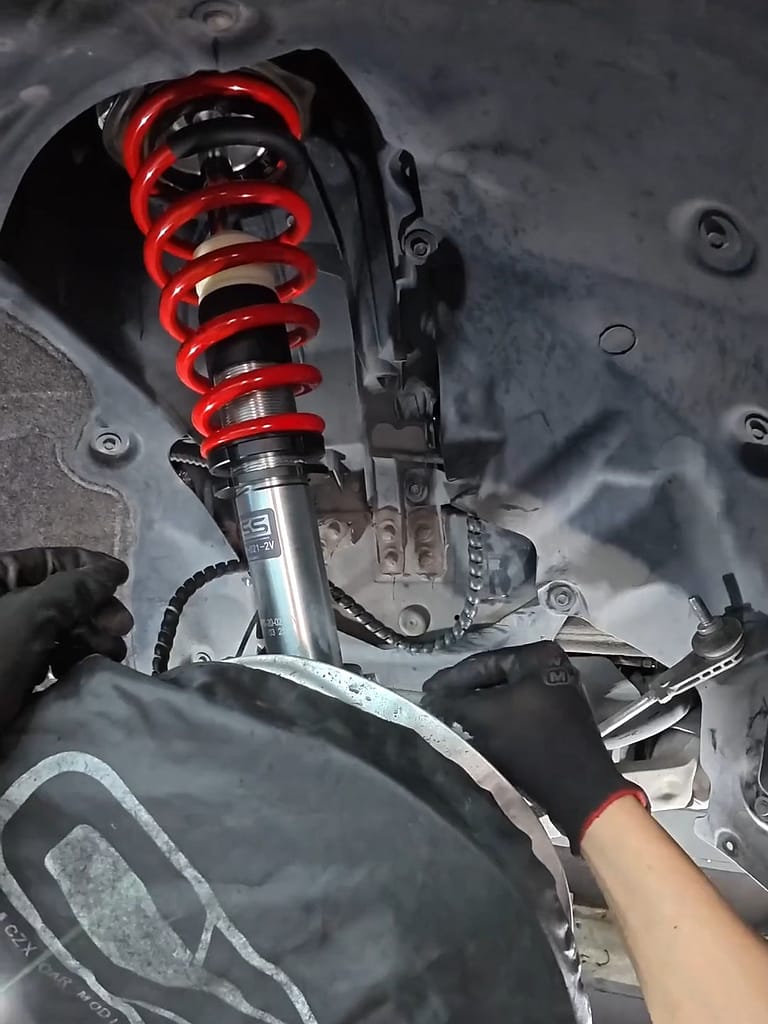
In the debate of shock absorber vs suspension, the shock absorber (often referred to as a damper) is a single, specific component within the larger suspension system. Its function is often misunderstood due to its name. It does not, in fact, “absorb shocks.” Instead, it is a velocity-sensitive hydraulic device whose job is to dampen and control the motion of the suspension springs. Without a shock absorber, the springs, which are excellent at absorbing initial impacts, would continue to oscillate after being compressed, causing the wheel to bounce uncontrollably. The shock absorber ensures that after a spring compresses and rebounds to absorb a bump, it returns to its rest position smoothly and without excessive bouncing. It converts the kinetic energy of suspension movement into heat, which is then dissipated.
The key takeaway in the shock absorber vs suspension comparison is this: You cannot have a functioning suspension without a shock absorber, but the shock absorber is just one part of the entire suspension ecosystem.
Section 2: The Suspension as a System: The Core Components of the “Big Picture”
To fully grasp the scope of the suspension, we must examine its major components. Performing a shock absorber vs suspension analysis is incomplete without acknowledging all the parts that constitute the suspension system.
- Springs: This is the most famous component. Whether they are coil springs, leaf springs, or torsion bars, springs are responsible for supporting the vehicle’s weight and absorbing the energy of road impacts. They provide the bounce. The most common types are coil springs and leaf springs. A coil spring vs leaf spring debate is a separate discussion, but both serve the same foundational purpose within the suspension.
- Control Arms and Links: These are the structural framework of the suspension. They connect the chassis to the wheel assembly (the knuckle or spindle), providing a defined range of motion for the wheel while maintaining its alignment (camber and caster). They are the “bones” that guide and position the wheel.
- Struts: Many modern vehicles use a shock absorber vs strut design, but they are very different. A strut is a structural suspension component that integrates the shock absorber, coil spring, and the steering knuckle into a single, compact unit. A vehicle with a strut-type front end has no separate upper control arm. In this design, the strut itself is part of the suspension’s structural support.
- Bushings, Ball Joints, and Sway Bars: These components ensure smooth articulation and reduce unwanted motion. Bushings (typically made of rubber or polyurethane) allow control arms to pivot. Ball joints provide a flexible pivot point between the control arms and the knuckle. Sway bars (or anti-roll bars) are torsion springs that link the wheels on the same axle together to reduce body roll during cornering.
Therefore, when discussing shock absorber vs suspension, the suspension is the sum total of springs, control arms, struts, bushings, and yes, the shock absorber. The shock absorber is just one critical piece of this complex puzzle.
Section 3: The Shock Absorber in Detail – The Damper’s Role in the Equation
Now, let’s focus exclusively on the star of our comparison: the shock absorber. We’ve established its purpose, but how does it perform its function so effectively, and how does it specifically manage the spring’s behavior, which is central to the shock absorber vs suspension dynamic?
A shock absorber is a sealed, oil-filled cylinder with a sliding piston rod. The secret to its operation lies in its velocity-sensitive valving.
- On a Smooth Road: The suspension moves slowly over small bumps. The piston inside the shock absorber moves at a low velocity. At low speeds, the oil flows easily through the small valves within the piston, offering minimal resistance. This allows for a comfortable ride.
- Over a Large Bump: During a sudden impact, the suspension (and the shock’s piston) moves very quickly. The rapid movement puts pressure on the hydraulic oil, forcing it through the valves at high pressure. This creates significant resistance, controlling the suspension’s movement and preventing the spring from over-compressing or bouncing excessively.
This ability to adapt its resistance to speed is what makes a shock absorber so effective. It “knows” whether the vehicle is gently rolling over a pebble or violently hitting a pothole and adjusts its damping force accordingly. In the context of shock absorber vs suspension, this precise, dynamic control is what prevents the entire suspension system from becoming unstable and uncontrollable.
Section 4: The Symbiotic Relationship: How a Shock Absorber and Suspension Work Together
The most critical insight from the shock absorber vs suspension comparison is understanding their synergy. They are not rivals but partners in a masterfully engineered system. The best analogy is the relationship between a spring and a damper in a clock or, more illustratively, a diving board.
- The Spring (Part of the Suspension) is the Diving Board: The spring absorbs the initial energy of a jump (the impact from a bump). It stores this energy and releases it, causing the object (or wheel) to bounce.
- The Shock Absorber is the Diver (Controlling the Bounce): If the diver just steps onto the diving board, it will bounce up and down several times. But the diver controls that bounce by bending their knees and absorbing the energy, ensuring a single, controlled movement to launch themselves. The shock absorber performs the exact same function for the spring.
Without a shock absorber, the suspension’s springs would cause the wheels to bounce, leading to a loss of traction, poor handling, and a very uncomfortable ride. Without the suspension’s springs, a shock absorber would have nothing to control—the vehicle would slam into the road with every bump. This partnership is the core of vehicle dynamics. Therefore, the debate of shock absorber vs suspension is a false dichotomy. The correct mindset is “shock absorber and suspension.” The shock absorber tames the spring’s energy, while the spring supports the vehicle’s weight. Together, with the control arms and other components, they form a functional suspension system that balances comfort and control.
Section 5: Diagnosing Problems: Symptoms of Failure in Shock Absorber vs Suspension
Understanding the shock absorber vs suspension distinction is a superpower for any driver or technician when it comes to diagnosis. The symptoms of failure are often specific to one component rather than the entire system.
| Symptom | Likely Culprit (Shock Absorber vs Suspension) | Explanation |
|---|---|---|
| Excessive Body Roll | Worn Shocks or Struts | The shock absorber’s primary job in cornering is to control body roll. If it’s weak, the car leans excessively through turns. |
| Nose Dives When Braking | Worn Shocks or Struts | The shock absorber cannot control the weight transfer to the front of the car, causing the front end to dive. |
| Rear Squat Under Acceleration | Worn Shocks or Struts | Conversely, it cannot control the lift at the rear of the vehicle during hard acceleration. |
| Vehicle Bounces/porpoises | Worn Shocks or Struts | This is the most classic sign. After hitting a bump, the car continues to rock up and down two or three times. |
| Leaking Fluid | Faulty Shock Absorber or Strut | The hydraulic oil is leaking past the seals, rendering the damper useless. |
| Uneven Tire Wear (Cupping) | Worn Shocks or Struts | Uncontrolled suspension movement causes the tires to hop and skip, leading to a scalloped, uneven wear pattern. |
| Clunking or Knocking Sound | Worn Control Arm Bushings, Ball Joints, or Sway Bar Links | This indicates play in the structural components of the suspension system, not the damping function of the shock absorber. |
| One Corner Sitting Lower | Broken Spring or Strut | A component of the suspension that supports weight (spring or strut body) is compromised. |
As you can see, a lot of instability points directly to the shock absorber vs suspension component of the shock absorber. However, if you hear clunking, the problem is more likely a bushing or joint in the suspension system.