Meta Description: Are there any systems to absorb shocks? As a leading manufacturer, the answer is a definitive yes: it’s called the vehicle’s suspension system. Learn how shock absorbers work within this comprehensive system to ensure safety and control.
Introduction
The question, “Are there any systems to absorb shocks?” is one we encounter frequently from consumers, enthusiasts, and even mechanics. While the question appears simple, the answer reveals the sophisticated engineering that underpins modern vehicle dynamics. A common misconception is to point directly to the shock absorber as the sole component responsible for this function. As a factory specializing in hydraulic damping, we are in a unique position to clarify this misunderstanding. The direct answer is: Yes, there are sophisticated systems designed to absorb shocks, but the shock absorber itself is merely one critical cog in a much larger, more complex machine. This machine is the vehicle suspension system. This article will delve into this integrated system, explaining its true purpose and how our core product—the shock absorber—functions within it to manage forces and provide the safety and performance we all take for granted.
Core Content
Section 1: The Existence of a Comprehensive System: Introducing the Suspension
So, are there any systems to absorb shocks? The answer is a resounding yes. That system is the vehicle’s suspension system. It is a masterfully engineered assembly of interconnected components that works in harmony to manage the dynamic forces between the vehicle’s chassis and the road surface. Viewing a shock absorber as an isolated “shock absorber” is like looking at a single piston and calling it an engine. A piston has a function, but it is useless without the block, crankshaft, and connecting rod that form the complete engine.
The suspension system fulfills five primary, interconnected functions that make up its overall “shock absorption” capability:
- Support Vehicle Weight: The system must support the static load of the entire vehicle, including the engine, passengers, and cargo.
- Isolate the Chassis from Road Irregularities: This is the most direct answer to the “absorb shocks” question. It filters out bumps, potholes, and other imperfections to provide a comfortable ride.
- Ensure Consistent Tire Contact: This is arguably its most critical safety function. It keeps the tires in firm contact with the road at all times, which is essential for traction, braking, acceleration, and steering.
- Control Body Motion: The system manages weight transfer during acceleration (squat), braking (dive), and cornering (roll), maintaining vehicle stability.
- Maintain Wheel Alignment: It keeps the wheels pointed in the correct direction, ensuring predictable handling and even tire wear.
Therefore, the system responsible for “absorbing shocks” is not a single part, but the suspension system. The shock absorber is vital to its successful operation, but it relies on every other component, including the springs, control arms, bushings, and sway bars.
Section 2: The Misconception: Debunking the “Shock Absorber” Name
The common misconception starts with the name itself. We manufacturer specialize in shock absorber production. However, the term is a misnomer in the context of absorbing a shock. As engineers, we know that the initial impact from a bump is not primarily absorbed by the shock absorber. This initial absorption is the job of another component: the springs.
- Step 1: The Spring Absorbs the Impact. When a wheel hits a pothole or a large bump, the first component that reacts is the suspension spring. It is soft by design, compressing to absorb the kinetic energy of the impact. Without this spring, the vehicle would slam into the road with destructive force.
- Step 2: The Dampers Take Over. Once the spring has absorbed the impact, it will rebound. The problem is that, like a yo-yo, a spring will continue to oscillate, causing the wheel to bounce up and down several times.
This is where the shock absorber (which we correctly refer to as a “damper”) plays its crucial role. Its job is not to absorb the initial impact, but to dampen, or control, this oscillation. By converting the kinetic energy of the spring’s rebound into heat, the shock absorber ensures that the wheel returns smoothly to its rest position, maintaining consistent tire contact with the road. The entire suspension system works in this sequence: spring first to absorb the hit, damper second to control the rebound.
Section 3: The Synergistic System: How Suspension Components Work Together
To fully understand the answer to “are there any systems to absorb shocks?”, we must look at the key components of the suspension system and how they interact. No single component works in isolation.
A. The Role of Springs Springs (coil, leaf, or torsion bars) are the primary “shock absorbers” in the system. Their job is to bear the vehicle’s load and absorb the initial energy of an impact. A soft spring will provide a very comfortable ride but may allow too much body roll. A stiff spring will provide better handling but a harsher ride. The choice of spring is a fundamental engineering decision for any vehicle.
B. The Role of Shock Absorbers (Dampers) As we’ve established, the shock absorber is the motion control device. It is the governor that tames the spring’s energy. Without a functioning shock absorber, the spring would cause the wheels to bounce violently, leading to a complete loss of control. The suspension system is critically unstable without its dampers.
C. The Role of Control Arms and Linkage These are the “bones” of the suspension system. They connect the chassis to the wheel hub (knuckle), providing a defined path for its movement. They are engineered with precisely designed pivot points (ball joints and bushings) to ensure the wheel maintains its proper alignment (camber, caster, and toe) as it moves up and down.
D. The Role of Sway Bars (Anti-Roll Bars) While primarily designed to manage body roll during cornering, sway bars are also integral to the system’s overall stability. They connect the wheels on the same axle and work by transferring force from one side of the vehicle to the other, resisting the roll of the vehicle’s body. This keeps more of the vehicle’s weight on the outside tires, increasing cornering grip.
E. The Role of Bushings and Joints These small, critical parts (made of rubber or polyurethane) are the silent heroes of the suspension system. They allow the metal control arms and links to pivot smoothly without transmitting harsh vibrations and noise directly into the cabin. Worn or dried-out bushings can lead to a clunky ride, poor handling, and accelerated tire wear.
Section 4: A Modern Integrated System: The Strut vs. Shock Absorber
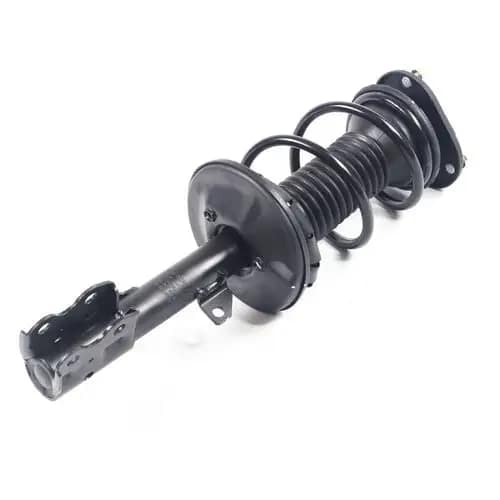
To further illustrate that the answer lies in a system, not a single part, we must introduce the shock absorber‘s close relative: the strut. A strut is not a different type of damping product in the way a coil spring is different from a torsion bar. A strut is an integrated structural suspension component that performs multiple functions.
In many modern vehicles, especially with front-wheel-drive layouts, the suspension system uses a strut assembly instead of a separate shock absorber and upper control arm. A strut assembly integrates:
- A shock absorber (damping unit).
- A coil spring.
- A spring seat.
- A strut bearing (for steering pivot).
- The steering knuckle mounting point.
The strut itself bears part of the vehicle’s weight and acts as the main structural pivot for the wheel assembly. In this configuration, the shock absorber is simply the damping element within the larger, all-encompassing strut system. This perfectly demonstrates that are any systems to absorb shocks? Yes, a strut suspension system is one such system, with the shock absorber being just one of its key components.
Section 5: The Impact of Leverage Systems: Suspension Geometry
An even deeper layer to the “are there any systems to absorb shocks?” question is the science of suspension geometry. The suspension system is not just about components; it’s also about the geometry and leverage designed into those components.
- Lever Ratios: How much the wheel moves for a given amount of shock absorber travel is determined by a lever ratio. This ratio is engineered to work with the spring and shock to deliver a specific ride/handling balance.
- Bump and Rebound Travel: The maximum distance the wheel can move into the wheel well is called bump travel. How far it can move out is rebound travel. These are carefully calculated to maximize tire contact without causing the suspension to bottom out or top out.
- Roll Center Height: This is an imaginary point around which the vehicle’s body rolls during cornering. Its height is a critical factor in handling and stability.
These geometric designs are part of the overarching suspension system strategy to manage forces and create predictable, safe, and comfortable vehicle dynamics. It is a system where the shock absorber’s performance is fine-tuned to work within this precise geometric framework.
Conclusion: The Answer is a System, Not a Part
So, to the critical question, “are there any systems to absorb shocks?” The definitive, engineer’s answer is yes. The system is the vehicle’s suspension system. It is a masterpiece of integrated engineering where each component plays a specialized and indispensable role. Springs absorb the initial impact, control arms guide the wheels, and bushings ensure smooth operation. Within this intricate web, the shock absorber acts as the primary damper, controlling the unwanted motions of the springs to ensure tires remain planted and the vehicle is stable. It is a quintessential example of a system being far greater and more critical than the sum of its parts. Understanding this holistic approach is the key to appreciating the true art and science of vehicle dynamics.