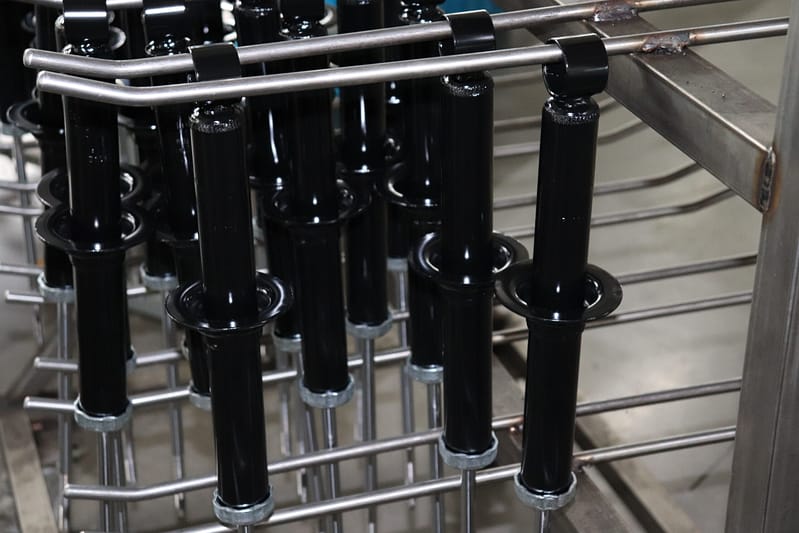
Meta Description: Ever wonder, how does a shock absorber work? As the manufacturer, we reveal the intricate engineering. Learn how shock absorbers use hydraulic damping to control springs, ensure tire contact, and ensure vehicle safety. A detailed technical guide.
Introduction
A shock absorber is a silent sentinel in the world of automotive engineering. Its function is essential, yet its mechanism remains a mystery to most vehicle owners. The common analogy—comparing a shock absorber to a syringe filled with fluid—is a starting point, but it only scratches the surface of the precision engineering involved. So, how does a shock absorber work? The simple answer is through the controlled dissipation of kinetic energy as heat. But the genius lies in the how—the meticulous valving, the hydraulic fluid dynamics, and the harmonious partnership with the suspension spring.
From our vantage point on the factory floor, where every component is subjected to thousands of hours of development and testing, we see a shock absorber not as a simple part, but as a sophisticated machine designed for a singular purpose: motion control. It’s easy to mistake its presence for ride comfort, but that is merely a secondary benefit. Its true, critical job is to manage the movement of the springs, ensuring that the vehicle’s tires maintain constant and optimal contact with the road surface. This article will take you on a detailed technical journey, breaking down the inner workings of a shock absorber from the perspective of the people who design and build them, revealing the principles that make it a cornerstone of modern vehicle safety and performance.
Core Content
Section 1: The Core Principle: It’s a Dampener, Not a Bump Absorber
Before we can explain the internal mechanics, we must address the most common and fundamental misconception: the shock absorber does not absorb road shocks. That is the precise job of the suspension spring. Whether it’s a coil spring on a car or a leaf spring on a truck, the spring is designed to be the compliant element. When a wheel hits a bump, the spring compresses, absorbing the initial impact and storing the energy. Without a shock absorber, the spring would do its job perfectly, but then release that energy with an equal and opposite force, causing the wheel and chassis to bounce violently and uncontrollably for several seconds.
1. The Synergy Between Spring and Shock Absorber
Think of the spring as the muscle and the shock absorber as the brain. The muscle provides the force, but the brain controls how and when that force is applied. The function of this dynamic partnership is to smooth out the ride without allowing the car to wallow or bounce. The shock absorber’s job is to dampen—or control—the spring’s oscillation. It does this by resisting the motion of the spring, slowing down both its compression and, most importantly, its rebound.
So, when you see a vehicle with worn-out shock absorbers bouncing down the road, you are witnessing a spring without a governor—a powerful but out-of-control system. The shock absorber tames this power, ensuring a single, controlled movement. This is the foundational principle of how a shock absorber works: it is not responsible for the initial bump, but for the aftermath.
Section 2: The Anatomy of a Hydraulic Shock Absorber
The most common type of shock absorber is the hydraulic twin-tube design. While gas-charged and monotube designs exist, the core principles are similar. The heart of any hydraulic shock is a sealed system containing a special hydraulic fluid, designed to be thermally stable and resist foaming.
Key Components:
- Outer Cylinder (Reservoir Tube): This is the main body of the shock absorber, containing the bulk of the hydraulic fluid.
- Inner Cylinder (Pressure Tube): A smaller tube that sits inside the outer cylinder. This is where the main piston and valving operate.
- Piston Rod: A large, highly polished steel rod that extends out of the shock body. It connects the shock absorber to the vehicle’s chassis or body.
- Piston: This is the “brain” of the shock absorber. It is attached to the piston rod and moves up and down inside the inner cylinder.
- Valving System: This is the most critical and complex part of the shock absorber. It consists of a series of precisely machined and calibrated valves, including:
- Compression Valves: Control the flow of fluid from one side of the piston to the other as the shock is compressed (e.g., when the wheel hits a bump).
- Rebound Valves: Control the fluid flow during the extension phase as the spring pushes the wheel back down. Rebound damping is generally much stronger than compression damping to control the spring’s energy.
- Base Valve (in Twin-Tube designs): A valve at the bottom of the shock that allows fluid to flow between the inner and outer cylinders as the piston moves.
- Seals: Critical components that keep the hydraulic fluid trapped within the pressure tube and the grease in the rod guide bearing, preventing contamination and maintaining pressure.
Section 3: The Step-by-Step Working Process
This is where we answer the question, how does a shock absorber work, by tracing the path of the hydraulic fluid through two key phases of its movement.
1. The Compression (or “Jounce”) Stroke: Hitting a Bump
As a wheel hits a bump in the road, the suspension travels upward. This movement pulls the shock absorber’s piston rod into the shock body, forcing the piston down the inner cylinder.
- Fluid Movement: As the piston descends, it compresses the fluid below it. Since this fluid is incompressible, it must go somewhere. It is forced through the tiny compression valves in the piston head into the larger volume above it.
- Valving Resistance: The compression valves are designed to offer a specific amount of resistance to the fluid flow. This resistance is what slows down the compression of the shock. The faster the wheel moves, the greater the pressure, and the stiffer the valve feels. This prevents the chassis from feeling “jarring” or overly stiff on small bumps, while still being capable of handling large impacts.
- Fluid Displacement: In a twin-tube design, the fluid that moves above the piston also pushes on the base valve at the bottom of the shock. This valve opens, allowing some fluid to pass into the outer reservoir tube. This two-way fluid displacement is crucial for managing large amounts of fluid displacement during fast strokes.
The result of this process is a controlled, smooth compression that allows the wheel to track over the bump without transmitting a harsh, jarring shock to the car’s cabin. The work done by forcing the fluid through the valves is converted into heat.
2. The Rebound (or “Extension”) Stroke: The Spring in Action
This is arguably the most important stroke for vehicle safety. After the wheel has passed the bump, the compressed suspension spring pushes the wheel back down to its rest position. This is the rebound stroke, and the goal is to control it.
- Fluid Movement: As the suspension extends, the rod pushes the piston back up the inner cylinder. Now, the piston is displacing fluid from above it to the chamber below. It is during this upward stroke that the fluid is forced through the rebound valves, which are significantly smaller and stiffer than the compression valves.
- Why Rebound is Critical: The spring is trying to release its stored energy quickly and forcefully. The rebound damping is intentionally much greater than compression damping. This high level of resistance is what prevents the spring from “over-extending” and causing the wheel to lift off the road or the chassis to “bounce.” By slowing down the rebound speed, the shock absorber allows the tire to stay in contact with the pavement, ready for the next road surface change.
- Heat Generation: Because the rebound valves are much smaller and the pressure is higher, this is where the shock absorber generates the vast majority of its heat. The intense shearing forces as the high-pressure fluid is forced through microscopic orifices is a highly effective way of converting kinetic energy into thermal energy.
The genius of the valving system is its non-linear behavior. The faster the piston moves (i.e., the more severe the bump or the more aggressive the driving), the higher the fluid pressure, and the stiffer the valves feel. This adaptive behavior is key to balancing comfort and performance.
Section 4: Beyond Basic Hydraulics: Gas Charging and Advanced Technology
To prevent a common hydraulic phenomenon known as “aeration” (where the fluid mixes with air and causes performance fade) and to improve consistency, especially with aggressive driving, manufacturers have evolved the basic design.
- Gas-Charging (Twin-Tube): In a conventional shock, fluid foams when the piston moves very fast, leading to a spongy, inconsistent feel. Gas-charged shocks are pressurized with a low-pressure (typically 100-150 psi) inert gas (like nitrogen) in the outer reservoir. This pressure prevents the fluid from foaming, ensuring more consistent damping characteristics even during heavy or sustained use.
- High-Pressure Gas-Charging (Monotube Shocks): These are the high-performance standard for most sports cars and trucks.
- Design: They are a single, high-pressure tube, with the separating piston floating between the hydraulic fluid and a high-pressure (300-500 psi) charge of nitrogen gas.
- How they work: The high-pressure gas provides better “hysteresis control” (resistance to change in damping force), leading to more precise handling. It also allows for a larger piston diameter for a given size, resulting in better damping force and heat dissipation capacity. The monotube design is also more efficient at dissipating heat, making it superior to twin-tube designs under extreme stress.
- Electronic Control (Adaptive Dampers): The pinnacle of shock absorber technology is the electronic damper.
- How they work: These shocks contain a solenoid-controlled valve that can change the size of the oil passage in real-time. The vehicle’s main computer receives data from accelerometers, speed sensors, and even steering wheel angle sensors. Based on this data, it can instantly adjust the firmness of all four shock absorbers.
- Function: This allows the car to offer multiple personalities, from a soft, comfortable “comfort” mode on the highway to a firm, body-roll-resistant “sport” mode on a winding road. It is the ultimate expression of how a shock absorber works: not just responding to input, but anticipating it and adapting to provide the optimal response for any given condition.
Conclusion
So, how does a shock absorber work? It is a masterclass in hydraulic engineering. It does not absorb bumps but, through a precisely calibrated system of pistons, valves, and incompressible fluid, it controls the oscillation of the springs. This controlled motion is converted into heat, which is then dissipated into the atmosphere. This elegant process ensures that the vehicle’s tires remain firmly planted on the road, which is the single most critical factor for safe braking, predictable cornering, and stable emergency handling. From the basic twin-tube to the sophisticated electronic monotube, the fundamental principle of dampening motion to ensure tire contact remains the cornerstone of the shock absorber’s function. It is a component whose complexity directly translates to your safety on the road.