Meta Description: How does a shock absorber work? As a manufacturer, we provide a definitive, expert answer. It’s a velocity-sensitive hydraulic damper that controls spring motion, not a cushion. Learn the critical engineering of shock absorbers.
Introduction
The term “shock absorber” is deeply embedded in the automotive lexicon. It’s a name so intuitive that few drivers ever question its accuracy. A common assumption is that its primary function is to absorb bumps and road shocks, ensuring a smooth ride. For us, a manufacturer who has engineered and produced millions of these components, this widespread misconception offers a valuable teaching moment. The true answer to the question “how does a shock absorber work?” is far more sophisticated, elegant, and critical to vehicle safety than the name suggests. So, let’s move beyond the surface-level understanding and provide a definitive, expert answer from the factory floor. How does a shock absorber work? It is a precision, velocity-sensitive hydraulic damper. Its real job is not to absorb bumps, but to control the motion of the vehicle’s suspension springs. In this article, we will dismantle the myths and rebuild your understanding from the ground up, explaining the precise engineering that makes a shock absorber one of the most critical safety components on your vehicle.
Core Content
Section 1: Debunking the Myth: The True Purpose of a Shock Absorber
Before diving into the mechanics, it’s crucial to correct the fundamental misunderstanding surrounding this component. How does a shock absorber work if not to absorb bumps? The answer lies in understanding a simple fact: your vehicle’s springs are responsible for absorbing the impact of a bump or pothole. When your tire hits an irregularity in the road, the spring compresses, storing the kinetic energy of the impact. After this initial compression, the spring must rebound, releasing that stored energy and allowing the wheel to return to its normal position.
However, an uncontrolled spring is a dangerous thing. Think of a ball dropped from a height. It hits the ground, bounces, and continues to bounce several times before coming to rest. If you replace this ball with a wheel attached to an uncontrolled spring, the result would be chaotic. The wheel would bounce multiple times after hitting a single bump, lifting off the road surface and compromising traction. This chaotic motion would make any vehicle impossible to control. This is precisely where the shock absorber’s function becomes clear. So, how does a shock absorber work in this context? It does not soften the initial impact; it dampens the rebound. After the spring has absorbed the bump, the shock absorber slows down the spring’s movement, ensuring it returns to its rest position smoothly and without excessive oscillation. How does a shock absorber work for safety? By ensuring the tire maintains consistent contact with the road after each and every imperfection.
Section 2: The Core Engineering Principle: It’s a Hydraulic Pump
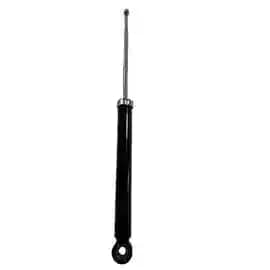
To truly understand how does a shock absorber work in detail, we must look at its internal components. At its heart, a shock absorber is nothing more than a precision hydraulic pump. Its sole purpose is to convert the kinetic energy from the suspension’s motion into heat, which is then dissipated into the atmosphere. The device consists of three main parts: a cylinder, a piston, and a cylinder rod.
The cylinder is a sealed tube filled with a specialized, stable hydraulic fluid. The piston rod is attached to a piston head and extends out of the cylinder at one end. The piston head features several small, precisely drilled orifices and one-way valves. As the suspension moves (either in compression or “jounce,” or in extension or “rebound”), the piston rod forces the piston to move up and down within the cylinder. This action forces the hydraulic fluid to pass through these orifices. The resistance the fluid encounters as it is forced through these narrow passages is what provides the damping force. Think of the difference between pouring water out of a large jug versus a bottle with a small opening. The flow is restricted by the opening; a shock absorber uses this principle on a microscopic scale to slow down high-velocity motion.
Therefore, when someone asks “how does a shock absorber work?”, the most accurate analogy is to describe it as a pump whose resistance is created by forcing fluid through tiny channels. This process generates heat, which is why a shock absorber can become very hot after a period of aggressive driving.
Section 3: Velocity Sensitivity: The Genius of Modern Shock Absorbers
One of the most brilliant aspects of a modern shock absorber’s design is its velocity sensitivity. How does a shock absorber work on a smooth road versus a bumpy one? The answer is that it adapts its resistance based on how fast the suspension is moving. This is a critical feature that provides both comfort and control.
- Slow Motion: When the suspension moves slowly over small bumps or during weight transfer, the piston speed is low. The shock absorber offers relatively little resistance, allowing the wheels to follow the contours of the road smoothly and ensuring a comfortable ride.
- High Velocity: When a wheel hits a large pothole or during cornering and braking, the suspension moves very quickly. At high piston speeds, the pressure inside the cylinder increases dramatically. This pressure forces the valves inside the piston to open, allowing more fluid to pass through more rapidly. The result is a significant increase in damping force, which is essential for controlling the violent suspension movements and keeping the tire planted on the ground.
This self-regulating mechanism is what makes a shock absorber so effective. How does a shock absorber work to be both compliant and firm? It’s a passive system that requires no input from the driver or computer to adjust to the changing demands of the road. This velocity-sensitive behavior is the cornerstone of handling and stability.
Section 4: The Gas-Charged Revolution: How Does a Shock Absorber Work Without Fading?
While the basic hydraulic design is effective, it has a significant limitation known as “aeration” or “foam.” How does a shock absorber work when it gets hot? During operation, the friction of the fluid moving through the valves generates heat. As the fluid heats up, its ability to hold air diminishes, causing it to foam. Just like a shaken soda, this foamy fluid becomes compressible. When a fluid is compressible, it can no longer effectively transfer force from the piston to the fluid passages. This phenomenon is called shock fade.
So, how does a shock absorber work to maintain performance under demanding conditions? The solution is gas-charging. Modern performance and heavy-duty shock absorbers are filled with high-pressure nitrogen gas. This innovation comes primarily in two designs: Twin-Tube and Monotube.
A. Twin-Tube Gas-Charged Shock Absorbers:
In this design, the original twin-tube configuration is modified. A separate low-pressure charge of nitrogen gas is added to the fluid reservoir in the outer tube. This gas pressurizes the fluid, preventing it from foaming and significantly reducing the likelihood of aeration. How does a shock absorber work as a twin-tube gas-charged unit? It functions similarly to a standard hydraulic unit, but the gas charge helps maintain fluid integrity for better fade resistance and a smoother ride. While an improvement, the still-present outer tube limits its ability to dissipate massive amounts of heat.
B. Monotube Shock Absorbers:
This is the gold standard for performance, heavy-duty, and racing applications. A monotube shock absorber consists of a single, large tube. Inside, a floating piston separates the oil from a high-pressure (250+ PSI) nitrogen charge. The nitrogen is on one side of this floating piston, and the hydraulic oil is on the other. How does a shock absorber work in a monotube design? The compression and rebound of the suspension directly moves a separate piston head within the oil. The high-pressure nitrogen charge serves two critical functions:
- It Prevents Aeration: Since the gas is physically separated from the oil by a floating piston, the oil cannot foam, eliminating the possibility of fade.
- It Assists in Heat Dissipation: The nitrogen charge above the oil acts like a second radiator. The heat generated by the oil is easily transferred through the floating piston into the gas, which has a large surface area to cool down.
For this reason, a monotube shock absorber can operate at higher temperatures for longer periods without performance degradation, making it the superior choice for demanding applications.
Section 5: The Impact on Vehicle Dynamics: How a Shock Absorber Works for Safety
Now that we understand the engineering, let’s connect it back to real-world performance. How does a shock absorber work to make your car safer?
- Braking Stability: When you brake, the car’s weight shifts forward, compressing the front suspension. A worn-out shock absorber cannot control this weight transfer effectively, causing the front end to “dive” excessively. The shock absorber’s resistance keeps the front suspension at an optimal angle, ensuring the front tires remain in firm contact with the pavement for maximum braking power.
- Cornering Control: When cornering, the car’s body leans to the outside. A properly functioning shock absorber controls this body roll by resisting the suspension’s movement. This keeps the vehicle stable and flat, ensuring all four tires contribute to lateral grip and reducing the risk of understeer or oversteer.
- Tire Wear: Uncontrolled suspension motion causes the tires to bounce, scrub, and hop along the road surface. This leads to uneven and rapid tire wear, often appearing as cupping or scalloping. A good shock absorber keeps the tires planted, promoting even and long-lasting tread wear.
Conclusion: Answering the Question “How Does a Shock Absorber Work?”
So, how does a shock absorber work? It is a sophisticated, velocity-sensitive hydraulic damber designed to manage the kinetic energy of the suspension springs. It does not absorb bumps—that is the spring’s job. Instead, it controls the spring’s rebound, ensuring a single, controlled cycle of motion rather than multiple, uncontrolled bounces. By forcing hydraulic fluid through precisely engineered internal valves, it converts kinetic energy into heat, adapting its resistance based on the speed of the suspension movement. Advanced designs like the gas-charged monotube shock absorber prevent performance fade, ensuring this damping function remains consistent under the most severe driving conditions. In essence, how does a shock absorber work as a safety system? It is the invisible hand that maintains constant tire-to-road contact, the single most important factor for ensuring stable braking, predictable cornering, and overall vehicle control. Understanding its true function is the first step toward appreciating its critical role as a safety component.