Meta Description: Curious how much should it cost to replace a shock absorber? As the manufacturer, we provide an expert breakdown of the price factors: part quality (OEM vs. aftermarket), labor, vehicle type, and location. Learn to get a fair price.
Introduction
For any car owner, few questions are as practical—and as fraught with uncertainty—as “how much should it cost to replace a shock absorber?” It’s not a question like, “What’s the price of a quart of oil?” which has a standard, universally understood cost. Shock absorber replacement involves labor, parts from various manufacturers, and different vehicle complexities, leading to a wide range of quotes that can leave a consumer feeling confused and vulnerable. Is a 200quoteasteal,orisa200 quote a steal, or is a 200quoteasteal,orisa1,000 quote a fair shake?
From our perspective as the original manufacturer of these components, we see this price confusion from both sides: the consumer trying to understand the value and the independent service center trying to communicate it. The cost of a shock absorber replacement is not a single number but a calculation based on several key variables. A “shock absorber” is not a single, monolithic product; it’s a category that includes everything from a basic gas-pressurized tube to complex, electronically controlled adaptive dampers.
This article will arm you with the knowledge you need to navigate the marketplace confidently. We will break down the costs from the ground up, starting with the price of the part itself, then moving to the labor required to install it, and finally explaining why these costs vary so dramatically. By understanding the factors that drive the price, you can recognize a fair estimate and make an informed decision that balances cost, quality, and your vehicle’s specific needs. After all, a shock absorber is a critical safety component, and its cost should reflect the engineering that goes into keeping you on the road.
Core Content
Section 1: The Variable Blueprint – Understanding the True Cost of the Part
The most significant variable in the cost equation is the part itself. Not all shock absorbers are created equal, and their price reflects everything from the quality of the materials to the sophistication of the technology.
1. The Hierarchy of Quality: Economy, Standard, and Premium (OEM)
When you’re quoted for “shocks,” the price will vary dramatically based on which tier of product you are being offered.
- Economy Aftermarket Shocks: These are the least expensive option, typically found in national auto parts stores’ budget lines. They are generally serviceable replacements designed to meet the absolute minimum functional requirements.
- Price Range: 30−30 – 30−60 per unit.
- What You’re Paying For: A basic tube, a hydraulic or low-pressure gas charge, and adequate seals. They will dampen the spring, but with less precision and longevity than other options. They are often made with less durable materials and may offer a less refined ride quality. They are a legitimate choice for an older, high-mileage vehicle where ride quality is a secondary concern to basic functionality.
- Standard Aftermarket Shocks (Gas Charged): This is the sweet spot for the majority of vehicles on the road. These are the best-selling shocks from major brands like KYB (Monomax), Bilstein, and Gabriel.
- Price Range: 60−60 – 60−150 per unit.
- What You’re Paying For: These shocks utilize a higher-pressure nitrogen gas charge (1-4 times higher than economy shocks). This gas pressure prevents the hydraulic oil from aeration (foaming) during hard use, which leads to a more consistent, fade-resistant performance. They are built with higher-quality steel components, better precision-machined valves, and more robust seals. The difference in ride quality, stability, and longevity compared to economy shocks is significant. As a factory, we engineer our standard-grade products to be a reliable, high-performance replacement that closely matches the original equipment (OEM) feel.
- Premium/OEM (Original Equipment Manufacturer) Shocks: This is the top tier, encompassing both the original brand shocks sold by the dealer and high-performance aftermarket options.
- Price Range: 100−100 – 100−350+ per unit.
- What You’re Paying For:
- OEM Shocks: These are the exact same shocks that were installed on the vehicle when it rolled off the assembly line. They are engineered specifically for the vehicle’s weight, handling characteristics, and ride tuning. They are the perfect match for a factory-perfect restoration or for a driver who demands the precise handling feel that was intended by the car’s engineers. The price premium includes the brand, the R&D costs, and the dealer’s margin.
- High-Performance Shocks: This category includes brands like Koni, Sachs, and Ohlins, as well as sport-oriented variants from Bilstein. These are not merely replacements; they are upgrades. They offer adjustable damping, use advanced valving technology, and are designed for aggressive driving, racing, or simply a sportier, tighter handling feel.
2. The Complexity Factor: Struts, Coil-Over Assemblies, and Air Shocks
The word “shock absorber” is often used generically, but it can refer to several different, more complex components, each with its own installation and cost implications.
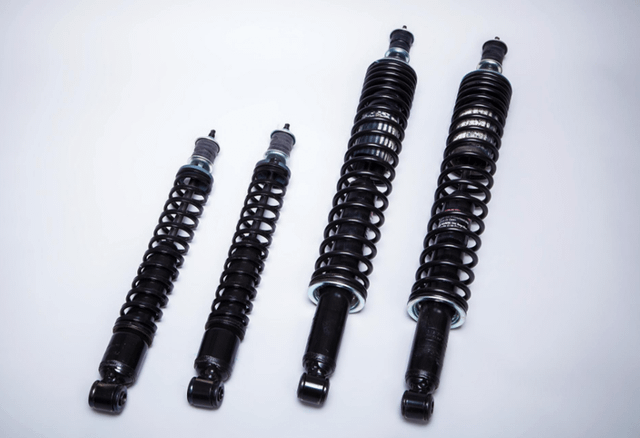
- Traditional Shock Absorbers: This is a simple unit consisting of a tube, a piston rod, and mounting hardware. It works in conjunction with a separate coil spring. Replacing it is straightforward and usually only requires the replacement of the shock itself.
- Strut Assemblies: On many modern cars, especially front-wheel-drive models, the shock absorber is integrated with a coil spring, a coil spring seat, and a bearing plate into a single unit called a strut assembly. This design saves space and weight but makes replacement more involved.
- Cost Impact:
- Part Price: A complete strut assembly is significantly more expensive than a standalone shock, often ranging from 150−150 – 150−400 per unit due to all the additional components.
- Labor Impact: Replacing a strut requires specialized tools (a spring compressor) to safely compress and remove the coil spring. This takes more time, skill, and carries a higher safety risk than changing a simple shock. Therefore, the labor cost is higher.
- Cost Impact:
- Coil-Over Systems: Common in performance vehicles and many SUVs, a coil-over unit integrates a shock absorber and a spring into a single, self-contained unit. They are often height and damping adjustable.
- Cost Impact: These are premium components, both for parts and labor. Expect part costs to easily exceed 300−300 – 300−500+ per corner. Installation can be complex, often requiring alignment afterward.
- Electronic/Air Shocks: On some luxury and SUV models, shocks are electronically controlled (e.g., Mercedes Airmatic, BMW Adaptive M, Audi Air Suspension) or use airbags instead of springs. These are the most complex and expensive systems.
- Cost Impact: A single electronic shock with its motor and sensors can cost 800−800 – 800−1,200+. The control modules, air lines, and compressors add to the immense cost. This type of repair is best left to dealerships or highly specialized shops.
Section 2: The Installation Equation – Deconstructing the Labor Cost
Once the part is selected, labor is the other major part of the equation. Labor costs can vary significantly from one shop to another. Here’s what you are paying for.
1. The Billable Hours
A mechanic’s labor rate is typically billed in tenths of an hour (6-minute increments). The time it takes to replace one shock can range from 0.3 hours to 1.5 hours or more, depending on the vehicle.
- Easy Access: For a vehicle like a Ford F-150 or a Chevrolet Silverado, accessing the rear shocks is often very simple, requiring just the removal of a single bolt. Labor for this is typically 0.3 to 0.6 hours per corner.
- Standard Access: Most passenger cars and SUVs fall into this category. They may require removing a wheel or a plastic inner fender liner to access the mounting hardware. Labor is typically 0.6 to 1.0 hours per corner.
- Difficult Access: Some European vehicles and many models require significant disassembly. On certain models, a shock replacement might require removing parts of the exhaust system, interior trim to access top mounts in the cabin, or other major components. This can easily push labor time to 1.5 hours or more per corner.
2. The Shop’s Overhead and Rate
The labor rate you are charged ($/hour) is determined by the shop’s location and its overhead.
- Dealership: Typically the highest rates (120−120 – 120−200+ per hour) due to expensive diagnostic equipment, factory training for technicians, and the highest overhead.
- Independent Chain/Big Brand Shops (e.g., Midas, Firestone): Moderate rates (90−90 – 90−130 per hour).
- Independent Local Mechanic: Often the lowest rates (80−80 – 80−110 per hour). They have less overhead but may not have the same specialized diagnostic tools as a dealer.
3. Absolute Non-Negotiable: The Four-Corner Rule
As a manufacturer, we cannot stress this enough: shock absorbers must always be replaced in pairs, preferably in sets of four. Your vehicle’s suspension is a balanced system. A shock absorber’s effectiveness depends on the damping force of its partner on the opposite corner. Replacing only one shock throws this balance completely off, leading to:
- A severely unbalanced ride and handling.
- Overloading and premature failure of the new shock.
- Rapid and severe wear of the tires on the side with the old shocks.
Therefore, the cost of replacement is almost always for two or four units.
Section 3: How Much Does It ACTUALLY Cost? Putting It All Together
Here is a realistic breakdown of the total cost for replacing a full set of four shocks on a common midsize sedan, like a Toyota Camry or Honda Accord. For this estimate, we’ll use a “standard aftermarket” shock and an independent shop labor rate of $100/hour.
- Part Cost: 4 shocks x 100/shock=∗∗100/shock = **100/shock=∗∗400**
- Labor Cost: 1.0 hour x 4 corners x 100/hour=∗∗100/hour = **100/hour=∗∗400**
- Alignment Cost (Highly Recommended): Replacing components that affect wheel geometry (like struts or if you’re doing a full set) requires a wheel alignment. This is a separate cost, usually around 80−80 – 80−120.
- Total Estimated Cost: 400(Parts)+400 (Parts) + 400(Parts)+400 (Labor) + 100(Alignment)=100 (Alignment) = 100(Alignment)=900
Quick Price Guide Summary:
| Vehicle Type | Part Quality | Labor Complexity | Estimated Cost Per Corner (Parts + Labor) |
|---|---|---|---|
| Compact Car/Sedan | Standard Aftermarket | Moderate | 150−150 – 150−250 |
| Midsize Car/Sedan | Premium/OEM | Moderate | 250−250 – 250−450 |
| Truck (F-150, Silverado) | Standard Aftermarket | Easy (Rear) / Moderate (Front) | 200−200 – 200−350 |
| SUV (e.g., 4Runner) | Standard Aftermarket | Moderate-High (Often Struts) | 250−250 – 250−450 |
| Performance Car | High-Performance Coil-Over | Difficult | 600−600 – 600−1,000+ |
Conclusion: Informed is the New Inexpensive
So, how much should it cost to replace a shock absorber? The answer is no longer a mystery. It is a calculated figure based on the quality of the part you choose and the complexity of the vehicle it’s going into. An estimate of 150to150 to 150to400 per corner for a standard quality replacement on a common vehicle is a realistic baseline.
Ultimately, the cost is an investment in three things: safety, performance, and long-term value. A worn shock absorber compromises safety, destroys tires, and ruins the driving experience. Replacing them with quality parts ensures predictable handling, shorter stopping distances, and a comfortable ride. It protects your investment in your car and, more importantly, protects you and your passengers on the road.
When you are getting quotes, don’t just look at the bottom line. Ask the mechanic what brand and quality of part they are using. Understand what the labor charge covers. In the context of vehicle maintenance, choosing the cheapest option can be the most expensive decision you make in the long run. Invest wisely, and you’ll be rewarded with a car that is not only a pleasure to drive but is safe and stable, delivering the performance it was designed to provide.