Meta Description: As a leading manufacturer of automotive components, we answer the critical question: Can worn shocks cause car wobble? Discover the science behind suspension instability and the direct link between shock absorber health and vehicle safety. Learn how to diagnose and prevent wobble from our factory experts.
Introduction
At our state-of-the-art manufacturing facility, where precision engineering meets rigorous quality control, we dedicate countless hours to understanding the intricate relationship between a vehicle’s components and its overall performance. One of the most frequent questions we field from distributors, mechanics, and concerned vehicle owners alike is: “Can worn shocks cause car wobble?”
The simple answer is nuanced. While a faulty shock absorber is rarely the sole culprit behind a violent, full-chassis oscillation like “death wobble,” it plays a far more significant and often misunderstood role than most people realize. Car wobble, particularly at highway speeds, is a complex issue rooted in suspension geometry. As the factory source for these critical parts, we want to demystify this problem. In this comprehensive guide, we will delve into the science of suspension dynamics, explain the critical functions of a shock absorber, and clarify its direct and indirect contributions to vehicle instability.
The terms “car wobble” can describe several different sensations, from a high-speed steering wheel shimmy to a more violent front-end shake. Understanding the distinction is key. Today, we will focus on the most concerning issue: a low-frequency, oscillatory wobble that affects the entire vehicle, often stemming from the front suspension. Our goal, as the manufacturer, is to provide you with the authoritative knowledge needed to diagnose the root cause of your vehicle’s instability and restore it to its designed, safe, and smooth-operating condition.
Understanding the Roles: The Shock Absorber vs. The Rest of the Suspension
To properly diagnose a wobble, one must first understand the unique and separate jobs of each component in the suspension system. A common misconception is that the shock absorber (or strut) is responsible for supporting the vehicle’s weight. This is incorrect. That is the primary job of the springs.
Think of your vehicle’s suspension as a team where each member has a specific, non-negotiable role. If one member fails to perform, the entire team’s efficiency is compromised, and failure can cascade through the system.
1. The Springs (The Supporters)
- Function: The springs (coil, leaf, or torsion bars) support the vehicle’s static weight and bear the dynamic load of cargo and passengers. They absorb large bumps by compressing and extending, storing and releasing energy.
- Analogy: The springs are like the main structural beams of a bridge. They provide the primary support.
- Failure Mode: A broken or sagging spring compromises the vehicle’s ride height and alignment, leading to poor handling but not directly causing a wobble on its own.
2. The Control Arms and Links (The Positioners)
- Function: These are the arms and links that connect the wheel assembly (knuckle) to the vehicle’s frame or subframe. They control the motion of the wheel, guiding it up and down while preventing forward or backward movement. Crucially, they determine the suspension geometry—angles like caster, camber, and toe—that are vital for straight-line stability and tire wear.
- Analogy: The control arms are like the precise guide rails on a train track, ensuring the wheel follows the correct path.
- Failure Mode: A worn or bent control arm, or loose ball joints/bushings, introduces play and alters the suspension geometry. This is a primary cause of instability and a major contributor to death wobble, as it creates the “slop” that initiates an oscillation.
3. The Stabilizer Bar (The Anti-Roll Specialist)
- Function: The anti-roll bar (or sway bar) connects the left and right sides of the suspension. Its job is to reduce body roll during cornering by transferring force from one side of the vehicle to the other, keeping the body more level.
- Analogy: It’s the bar connecting the two sides of a gymnast’s balance beam.
- Failure Mode: Worn or loose stabilizer bar links or bushings reduce the vehicle’s stability in corners and can contribute to a general feeling of vagueness but are less often the direct cause of a high-speed wobble.
4. The Shock Absorbers (The Dampers)
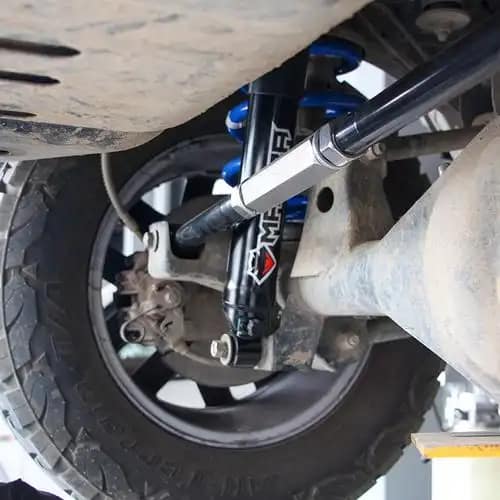
- Function: Here is where we focus our attention. The shock absorber (often called a damper) does not absorb shock—that’s the spring’s job. Its sole purpose is to control the motion of the spring. Every time a spring compresses or rebounds, the shock absorber works to slow down that movement, ensuring the spring returns to its neutral position smoothly and quickly without bouncing.
- Analogy: If the spring is a pogo stick, the shock is the hydraulic mechanism inside that stops it from bouncing uncontrollably after each jump.
- Failure Mode: A worn-out shock absorber has lost its damping ability. It allows the springs and attached components to oscillate freely and excessively.
The Critical, Indirect Role of Worn Shocks in Causing Wobble
Now, we can answer the central question with the factory-approved understanding. Can worn shocks cause car wobble? While they may not be the initiating factor like a loose control arm, worn shocks are a critical enabling factor. They actively participate in creating the environment that allows a wobble to begin and, more importantly, they prevent the system from stopping it.
Here is the step-by-step breakdown from our engineering perspective:
Step 1: The Trigger The wobble is almost always initiated by a sudden, sharp input or an existing mechanical defect. This could be:
- Hitting a pothole or a seam in the highway.
- A small bump in the road.
- A pre-existing condition like slightly worn tie rod ends, a loose track bar (on trucks and SUVs), or a worn ball joint.
These components introduce a small, sudden change in the steering or suspension geometry, forcing the tires and wheels to deviate from their intended path. This is the spark that ignites the problem.
Step 2: The Uncontrolled Oscillation In a healthy suspension with good shocks, this single trigger event would be a brief, damped movement. The shock would immediately control the spring’s energy, and the suspension would settle back to a stable state within a fraction of a second.
However, if the shocks are worn out, they cannot perform this damping function. When a worn shock allows a wheel to move over a bump, the connected spring is allowed to compress and rebound with minimal resistance. This sets up a small, uncontrolled oscillation in that corner of the vehicle. Instead of settling, the wheel and assembly “bounces” multiple times. This repeated bouncing puts energy back into the system.
Step 3: The Amplification Phase This is where the worn shock becomes a primary driver of the wobble. As the wheel continues to bounce, it begins to “steer” the vehicle. Each time the wheel bounces up, it changes the camber and toe, causing the vehicle to pull slightly left or right. The driver, feeling this pull, might instinctively make a tiny steering correction.
With worn shocks, this correction doesn’t settle the vehicle. Instead, the steering input meets the still-oscillating suspension, creating a resonance. The front of the vehicle begins to “hunt” or “shake” back and forth. If there is even a small amount of play in other components (like a slightly loose tie rod or ball joint), this play gets taken up by the oscillation, turning a small vibration into a large, violent wobble.
The Factory Analogy: A Pendulum Imagine a large pendulum. The force of gravity is what causes it to swing. If you give it a push, it will swing back and forth. The worn shocks are like removing the mechanism that is supposed to slow the pendulum down. It will swing wildly, gaining energy with each pass, until it is actively stopped. The mechanical defect (loose part) is the initial push. The worn shocks are the lack of a braking system that allows the pendulum’s motion to grow out of control.
How to Diagnose Worn Shocks (A Factory Technician’s Guide)
As the manufacturer, we recommend a systematic approach to diagnosing your suspension. Don’t just replace parts randomly.
1. The Visual Inspection (The Bounce Test) This is the simplest test. With the vehicle on level ground, firmly press down on the corner of the vehicle.
- Good Shock: The vehicle should bounce once and then settle back to its normal height.
- Worn Shock: The vehicle will bounce two or more times before settling. This is a clear sign that the damping fluid has leaked or the internal valving is worn out.
2. The Physical Check for “Wobble-Causing” Components A worn shock is half the battle. You must also inspect the components that initiate the instability.
- Grab the Tire: With the vehicle safely lifted, grip the tire at the 12 and 6 o’clock positions and try to rock it in and out. Excessive play indicates a bad wheel bearing or worn ball joints/tie rod ends.
- Check Mounting Points: Visually inspect all control arm bushings, ball joints, and the track bar (on applicable vehicles) for cracking, tearing, or obvious play. Wiggle components by hand to feel for looseness.
- Inspect the Tie Rods: Have a helper turn the steering wheel slightly back and forth while you watch the tie rod ends. Any visible play indicates wear.
3. The Tire Check Unbalanced or unevenly worn tires are a classic trigger for a front-end wobble. Inspect the tires for “cupping” or “scalloping” (dips in the tread), which is a tell-tale sign of worn shocks allowing the tire to bounce. Also, check tire pressures.
The Solution: Upgrading from OEM Performance
If your diagnostics point to worn shocks, we strongly advise not simply replacing them with an identical, basic OEM unit. As a manufacturer focused on performance and safety, we advocate for upgrading to a high-performance shock absorber.
Why Upgrade?
- Improved Damping: Premium shocks use advanced valving and higher-quality fluid to provide superior control, significantly reducing the risk of initiating an oscillation.
- Better Stability: Upgraded shocks (like gas-charged models) are specifically designed to keep the tire planted firmly on the road, improving steering response and overall stability, especially at highway speeds.
- Enhanced Durability: They are built to withstand harsher conditions and more frequent use than standard units, providing a longer service life and consistent performance.
- Corrected Ride Height: Some performance shocks are designed to work with lowering springs or can help restore a proper ride height on older vehicles that have sagged, which in turn improves suspension geometry.
Conclusion
So, can worn shocks cause car wobble? The definitive answer from our factory floor is: Yes, they are a critical and often-overlooked contributing factor. While a loose tie rod or ball joint may provide the initial “spark,” worn shock absorbers are the “fuel” that allows the resulting oscillation to grow into a dangerous, full-chassis wobble. They fail to dampen the suspension’s movement, allowing a small bump to trigger a continuous, uncontrolled feedback loop.
As the experts who design and manufacture these components, we urge vehicle owners to view their suspension as an integrated system. Diagnose all components—control arms, tie rods, and especially the shock absorbers—to get to the true root cause of instability. By understanding the science behind the wobble and choosing a high-quality replacement part, you not only solve the immediate problem but also restore your vehicle’s intended safety, handling, and performance. Your safety on the road is, and always will be, our highest priority.