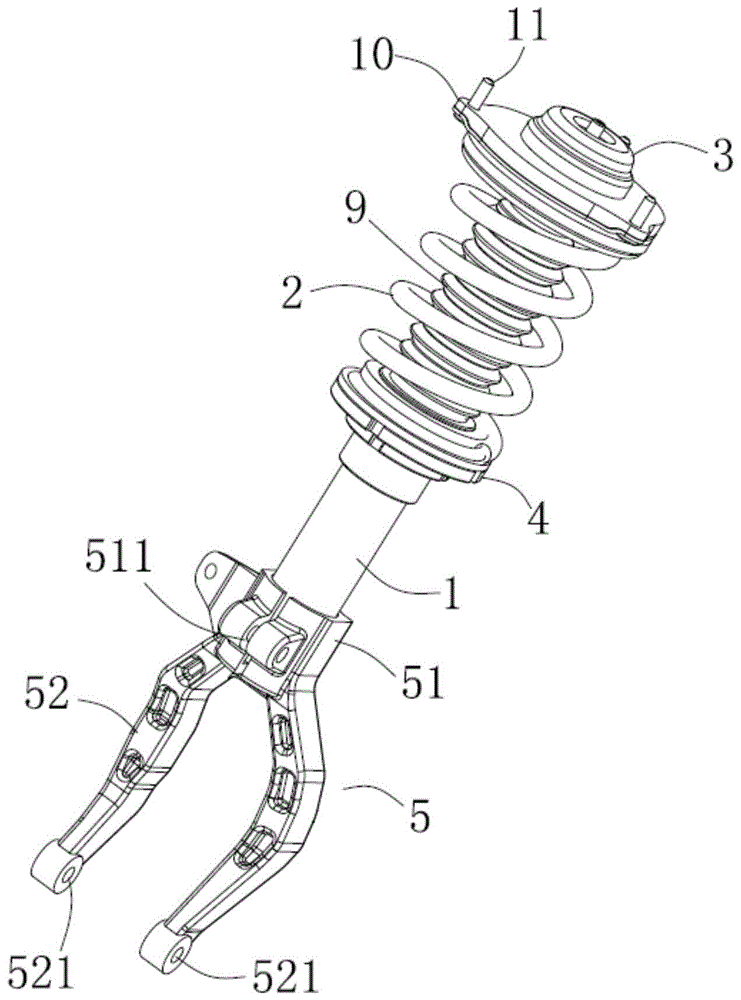
Meta Description: What are shock absorbers? As a manufacturer, we provide an in-depth explanation. Beyond being misunderstood comfort devices, they are velocity-sensitive safety systems controlling spring motion to ensure tire contact, stability, and control. Learn the real definition here.
Introduction
In the intricate machinery of an automobile, few components are as frequently misunderstood as the shock absorber. When people ask, “What are shock absorbers?” the most common response is, “They’re the parts that make the ride smooth.” While this is an observable outcome, it is a fundamental simplification that obscures their true and vital purpose. From our vantage point on the factory floor—where these components are engineered, forged, and subjected to relentless testing—we must provide a more precise and authoritative answer.
What are shock absorbers? They are not comfort devices; they are sophisticated velocity-sensitive damping systems. Their essential job is to manage the kinetic energy generated by the suspension springs, preventing uncontrolled movement. To put it simply, when you hit a bump, the spring absorbs the initial impact. The shock absorber’s role is to bring that spring back to its neutral position smoothly and without rebounding excessively. Without them, a car would be an uncontrollable, bouncy machine. This article will serve as a definitive guide, written from a manufacturer’s perspective, to fully explain what are shock absorbers, moving beyond the misconception of comfort to reveal their critical function as the guardians of vehicle safety and control.
Core Content
Section 1: Debunking the Myth: The True Nature of Shock Absorbers
The first step to understanding what are shock absorbers is to correct the central misconception perpetuated by their name. They do not, in fact, “absorb shocks.” A careful observer will note that most vehicles have a spring located near the shock absorber. This spring is the component actually designed to absorb the initial jolt from a road imperfection. The spring compresses, storing the energy of the impact and cushioning the chassis from the immediate force.
So, if the spring handles the initial “shock,” what are shock absorbers for? They are for controlling the aftermath. If a vehicle’s suspension consisted only of springs, every time a wheel hit a bump, it would rebound, oscillating up and down uncontrollably. This bouncing would continue until the energy was fully dissipated, making driving impossible, unsafe, and deeply unpleasant. This is precisely where the shock absorber’s function is critical.
What are shock absorbers in this context? They are motion dampers. They are essentially sophisticated hydraulic pumps. As they force fluid through internal valves, they generate precisely calibrated resistance. This resistance slows down and controls the speed at which the suspension can move. A shock absorber compresses and extends relatively slowly, allowing the spring to do its job while controlling its rebound, thus transforming a potentially violent impact into a single, controlled motion. This distinction—between motion control and shock absorption—is the core of what are shock absorbers.
Section 2: The Primary Function: Maintaining Tire-to-Road Contact
From a manufacturer’s standpoint, the single most important function of what are shock absorbers is to ensure the vehicle’s tires maintain constant and uninterrupted contact with the road surface. The four small patches where your tires meet the pavement represent the only connection your vehicle has with the physical world. Every action you perform—braking, accelerating, steering, or swerving—relies entirely on the friction generated at these four contact patches.
If any tire loses contact, all control is lost. What are shock absorbers designed to prevent this exact scenario? By controlling suspension oscillations, they keep the tire firmly planted.
- During Braking: When you apply the brakes, the vehicle’s weight shifts forward. If the front shocks are worn, the front of the car will dive excessively. This can unload the rear tires, causing instability, and if the dive is severe enough, it can lift a front wheel off the ground, rendering the brakes ineffective. The question, what are shock absorbers, is answered here: they are the key to balanced, effective braking.
- During Cornering: When turning, centrifugal force causes the car’s weight to shift to the outside wheels, leading to body roll. Worn shocks allow for excessive body roll, which can cause the inside tires to lose grip, dramatically reducing the vehicle’s stability and increasing the risk of a rollover. This behavior underscores the importance of understanding what are shock absorbers in a performance context; they control body roll.
- On Uneven Surfaces: Gravel, potholes, and bumpy roads cause the wheels to move rapidly up and down. Healthy shock absorbers control this motion, ensuring each tire maintains traction at all times. This allows the driver to maintain steering and throttle control. Without this damping, the wheels would skip and hop, leading to a complete loss of control. This is the most fundamental demonstration of what are shock absorbers do in real-world driving.
Section 3: The Critical Impact on Safety and Vehicle Dynamics
The function of maintaining tire contact directly translates into tangible safety and performance benefits. This is the true measure of what are shock absorbers contribute to a vehicle.
- Enhanced Stability and Reduced Stopping Distance: By preventing excessive body roll and brake dive, what are shock absorbers provide a more stable platform. This stability translates into shorter and more predictable stopping distances, as the tires are optimized for grip. A vehicle with functioning shocks is more stable in an emergency evasive maneuver.
- Improved Handling and Control: A car with healthy shock absorbers feels solid, planted, and responsive. It turns into corners without the unnerving wallow of a worn-out system and feels secure on the highway, even in windy conditions. This feeling of control is what drivers seek when they ask, what are shock absorbers supposed to make my car feel like? The answer is “controlled and predictable.”
- Increased Tire Life and Protection of Components: By preventing tire hop and ensuring even contact pressure, good shock absorbers promote even tire wear. They also protect other suspension components, like control arm bushings and ball joints, by managing the stress loads that uncontrolled suspension movements would place upon them. This extended life and protection are an often-overlooked benefit of what are shock absorbers are designed to deliver.
Section 4: Understanding the Technology: A Look Inside the Component
To fully grasp what are shock absorbers, it helps to understand the common technologies employed.
- Twin-Tube Design: This is the most common design for standard passenger cars and light trucks. It consists of two cylinders: an outer pressure tube and an inner working tube filled with hydraulic fluid. As the piston moves in the inner tube, fluid is forced through valves, creating resistance. The outer tube contains the excess fluid and a gas charge to prevent aeration. This design is cost-effective and provides a good balance of comfort and performance.
- Monotube Design: This high-performance design consists of a single, large cylinder. A floating piston separates the hydraulic oil from a high-pressure (often nitrogen) gas charge. This design is superior in dissipating heat and is immune to the performance-robbing effects of aeration. It is commonly found in performance vehicles, heavy-duty trucks, and off-road applications because it can handle higher stress and repeated use without fade.
- Adaptive / Semi-Active Shocks: These represent the cutting edge of shock absorber technology. Systems like Magnetic Ride Control use shocks filled with a magneto-rheological (MR) fluid. This fluid contains tiny iron particles whose viscosity can be instantly changed by an electrical current. What are shock absorbers in a system like this? They are smart, active components. The car’s computer constantly analyzes driving conditions and adjusts the shock firmness in milliseconds, offering a seamless blend of a comfortable ride and sharp handling.
Section 5: Signs of Wear and the Importance of Replacement
Knowing what are shock absorbers is only valuable if you can identify when they are failing. Shock absorber failure is gradual, making it easy to become accustomed to poor handling.
Key signs that your shock absorbers may be worn and need inspection and potential replacement include:
- The vehicle bounces more than once or twice after going over a bump.
- Noticeable “nose dive” when braking or “rear squat” when accelerating.
- Excessive body lean or sway when cornering.
- A feeling of instability or “floating” on the highway.
- Uneven or “cupped” tire wear patterns.
- Leaking fluid on the shock body.
When these symptoms appear, it is crucial to have them checked by a qualified technician. As a critical safety component, ignoring the question of what are shock absorbers doing on your car when they are failing is a serious safety risk.
Conclusion
So, we return to the original question: What are shock absorbers? They are far more than a simple comfort accessory. As a manufacturer, we define them as sophisticated, velocity-sensitive damping systems that control the motion of the springs. This control is the bedrock of their function, which is to keep the vehicle’s tires in constant contact with the road. This singular capability is the foundation of vehicle safety, as it ensures predictable braking, stable cornering, and overall control. They are an unsung, yet essential, safety system that works silently to protect the driver and passengers. Understanding what are shock absorbers to be at their core is the key to appreciating the engineering and design that goes into creating a safe, stable, and controllable vehicle.