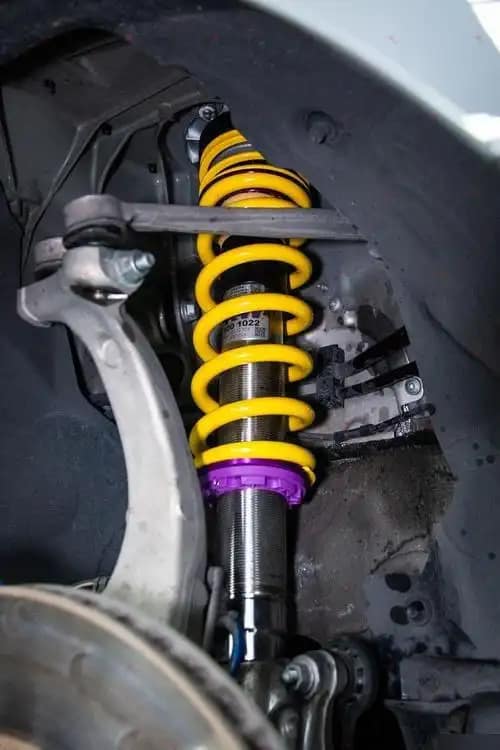
Meta Description: What does a shock absorber do? As a leading manufacturer, we provide a definitive expert answer. It’s not for absorbing bumps but for controlling spring motion to ensure safety, stability, and tire contact. Learn the critical function of shock absorbers.
Introduction
To the average driver, the name “shock absorber” seems intuitive. One might assume its purpose is to absorb the shocks and jolts from the road, providing a comfortable ride. This common misconception, while understandable, is the single greatest misunderstanding of a component that is fundamental to vehicle safety and control. As a manufacturer who has specialized in precision hydraulic damping systems for decades, our mission is to demystify the engineering behind every part we produce. So, let’s begin with a clear, unambiguous answer: what does a shock absorber do? A shock absorber is a velocity-sensitive hydraulic damper. Its primary function is not to absorb road impacts—that job belongs to the suspension springs—but to control the unwanted motion of those springs after they have compressed and rebounded. In this detailed engineering breakdown, we will move beyond the surface-level assumptions and provide an expert-level explanation of what a shock absorber truly does, dissecting its role in safety, vehicle dynamics, and overall performance.
Core Content
Section 1: Debunking the Myth: What a Shock Absorber Doesn’t Do
To fully understand what does a shock absorber do, it is essential to first understand what it does not do. The name itself is, ironically, a misnomer. The shock absorber is not a shock-absorbing component in the way a sponge or a cushion absorbs impact.
The very first task of a vehicle’s suspension when encountering a bump or pothole is handled by the springs. Whether they are coil springs, leaf springs, or torsion bars, the springs are designed to be soft and compliant. When a wheel hits an obstacle, the spring compresses, absorbing the kinetic energy of the impact. This initial absorption is the spring’s domain.
If the system were to end there, the spring would rebound forcefully, causing the wheel to bounce off the road surface, followed by several smaller oscillations. The results would be catastrophic: loss of traction, unpredictable handling, and a severe compromise of vehicle control. The shock absorber’s job is not to prevent that initial spring compression. Instead, it’s the crucial component that comes after the spring has done its job. What does a shock absorber do at this precise moment? It acts as a governor on the spring’s energy, ensuring it returns to its rest position smoothly and without continued bouncing, thereby maintaining the tire’s contact with the road.
Section 2: The Core Function of a Shock Absorber: Controlling Spring Motion
So, with the myth debunked, we arrive at the true purpose of a shock absorber: it is a damper. Its singular job is to dampen the oscillation of the suspension springs. What does a shock absorber do when it dampens? It converts the kinetic energy of the moving suspension into heat, which is then dissipated into the atmosphere.
Let’s visualize the process. A shock absorber consists of a main cylinder filled with a specialized, stable hydraulic fluid. A piston rod connects a piston head to the suspension’s moving parts (either the wheel knuckle or vehicle body). As the wheel moves up or down (over a bump or into a dip), the piston moves within the cylinder, forcing the fluid to pass through a series of precisely calibrated orifices and valves within the piston.
Think of the difference between pouring water from a wide pitcher versus a narrow-necked bottle. The narrow opening restricts the flow. A shock absorber uses this principle on a microscopic scale. The resistance the fluid feels as it’s forced through these tiny passages is what creates the damping force. This process generates a significant amount of heat, which is why a shock absorber can become quite hot after aggressive driving. This conversion of motion into heat is the fundamental mechanism by which a shock absorber exerts control over the spring.
Section 3: The Genius of Velocity Sensitivity: Adapting to Road Conditions
A feature that defines a high-quality shock absorber and elevates its operation is its velocity sensitivity. This means what does a shock absorber do on a smooth road versus a rough one? It adapts its resistance based on the speed of its movement. This is a passive, elegant, and critical feature for vehicle comfort and safety.
- During Slow Suspension Movement: When the vehicle is simply rolling over smooth asphalt or small, gentle bumps, the shock absorber’s piston moves slowly. At low speeds, the fluid flows relatively easily through the valves, meaning the damping force is low. This allows the wheels to follow the contours of the road without jarring the occupants, providing a comfortable ride.
- During Fast Suspension Movement: Now, imagine the wheel hits a large pothole or the car takes a sharp corner. In these instances, the suspension—and thus the shock’s piston—moves very rapidly. At high speeds, the fluid is forced through the orifices with immense pressure. This pressure forces the internal valves to open in such a way that allows high volumes of fluid to pass quickly. The result is a massive increase in damping force. This strong resistance is essential to immediately control the violent motion of the spring, keeping the tire firmly planted on the ground.
This ability to differentiate between slow and fast motion is what makes a shock absorber so effective. It provides a soft, compliant ride under normal conditions and transforms into a stiff, firm control arm when extreme forces are introduced. What does a shock absorber do during an emergency brake? It resists the rapid forward dive of the vehicle’s nose, ensuring the front tires maintain maximum traction for stopping.
Section 4: The Profound Impact on Vehicle Safety and Dynamics
The true answer to the question “what does a shock absorber do?” extends far beyond the realm of comfort. It is a critical safety component whose performance directly dictates a vehicle’s stability and handling. Here are the key safety-related functions of a shock absorber:
1. Maintaining Tire Contact: This is arguably the most important safety function. What does a shock absorber do that improves safety more than anything else? It ensures that your tires are always in contact with the road surface. A tire that is bouncing in the air is a tire that cannot brake, steer, or accelerate. The shock absorber’s ability to control spring oscillation is the primary mechanism guaranteeing this constant contact, which is the foundation of all vehicle control.
2. Enhancing Braking Performance: When you apply the brakes, the vehicle’s weight shifts dramatically forward. This is known as “brake dive.” Without a functioning shock absorber, the front suspension would compress excessively, lifting the rear of the car and reducing the weight on the front tires. A quality shock absorber controls this weight transfer, keeping the vehicle’s body at a more stable angle. This ensures the front tires remain firmly on the pavement, maximizing braking power and reducing stopping distances.
3. Improving Cornering Stability: During cornering, centrifugal force causes the vehicle’s body to roll to the outside. This body roll can destabilize the car and reduce the grip of the inside tires. The shock absorber works in concert with other suspension components to control this roll, helping to keep the car flat and stable through a turn. This predictable, neutral handling is essential for avoiding understeer (plowing) and oversteer (spinning out).
4. Promoting Tire Longevity: Uncontrolled suspension movement causes tires to “hop” and “skip” along the road surface. This leads to uneven tire wear, often a scalloped or cupped pattern. By keeping the tire firmly planted, a shock absorber ensures the tread wears evenly, maximizing the life of your tires and saving you money in the long run.
Section 5: Understanding Variations: Struts vs. Shock Absorbers
To fully answer “what does a shock absorber do,” it’s important to distinguish it from its close cousin, the strut. While often used interchangeably in casual conversation, they are different components, although a strut contains a shock absorber.
- A Shock Absorber: As we’ve detailed, it is a separate, standalone component whose only job is damping. It is mounted to the vehicle and connects to the wheel’s control arms via a linkage.
- A Strut: A strut is a structural suspension component. It integrates the shock absorber, a coil spring, and the steering knuckle into a single, compact unit. In a MacPherson strut suspension, the strut itself serves as the upper pivot point for the wheel. So, when asking “what does a shock absorber do vs. what does a strut do?” the answer is: The strut is part of the car’s structural frame, while the shock absorber is a dedicated damping device. A strut assembly has a shock absorber built inside it.
Therefore, the vast majority of modern vehicles either use a strut or a shock absorber as part of their suspension design. Understanding this difference is key for proper maintenance and diagnostics.
Conclusion: The Final, Unambiguous Answer
So, what does a shock absorber do? It is far more than just a comfort feature; it is a sophisticated, velocity-sensitive hydraulic damper and a cornerstone of vehicle safety and dynamics. It does not absorb road bumps—that is the job of the springs. Instead, it works in concert with the springs to control their motion after an impact. By converting the kinetic energy of suspension travel into heat, the shock absorber ensures that the springs return to their rest position smoothly, preventing the wheel from bouncing off the road. This single function has profound safety implications: it maintains tire contact, ensures stable braking and predictable cornering, and promotes even tire wear. The next time you wonder, “what does a shock absorber do?” you can provide the definitive answer: it is the unsung hero that keeps your vehicle planted, stable, and firmly in contact with the pavement, transforming the springs’ bounce into controlled, confident motion.