Meta Description: What does a shock absorber do on a truck? From our factory, we explain how truck shock absorbers control heavy-load stability, manage trailer sway, and absorb massive kinetic energy for safety. Learn the critical role of heavy-duty shock absorbers for towing and hauling.
Introduction
In the demanding world of transportation, where payloads are heavy, roads are unforgiving, and safety is non-negotiable, the question “what does a shock absorber do on a truck?” takes on a magnitude far beyond that of a passenger car. While the fundamental principle of damping suspension motion remains the same, the scale, complexity, and consequences of failure on a truck are exponentially greater. For us, as manufacturers of heavy-duty components, understanding what does a shock absorber do on a truck is not just about performance; it’s about engineering for integrity under extreme stress. It’s about a system designed to manage colossal kinetic energy, stabilize multi-ton loads, and keep the vehicle planted in the most challenging conditions. A simple comfort-focused answer to what does a shock absorber do on a truck is dangerously inadequate. A truck’s shock absorber is a robust, highly engineered damper acting as the critical link between immense physical forces and the driver’s ability to maintain control. In this definitive guide, we will dissect this critical component, providing a clear, expert answer to: what does a shock absorber do on a truck?
Core Content
Section 1: Beyond Passenger Cars: The Elevated Stakes of What a Shock Absorber Does on a Truck
To comprehend what does a shock absorber do on a truck, one must first appreciate the sheer scale of the forces involved. A passenger car might manage a few hundred pounds of weight transfer; a truck can manage thousands. This fundamental difference shifts the primary function of a shock absorber from a primarily “comfort-focused” device to a “stability and safety-critical” system. So, what does a shock absorber do on a truck to justify this elevated role? The answer lies in its capability to manage two primary challenges: the immense weight of the vehicle itself and the dynamic forces exerted by a heavy trailer.
What does a shock absorber do on a truck when it’s empty? Even without a payload, a truck has a high center of gravity and significant mass. A functional shock absorber ensures stability, reducing roll on corners and keeping the tires firmly planted for predictable handling. What does a shock absorber do on a truck when it’s fully loaded? This is where its role becomes most critical. As a truck is loaded, the rear suspension compresses significantly, altering the vehicle’s geometry and weight distribution. The shock absorber must now work in conjunction with heavy-duty springs to control this compressed state, preventing the rear from “squatting” under acceleration and ensuring that the truck remains level and stable during braking and cornering. Therefore, understanding what does a shock absorber do on a truck requires a perspective that accounts for dynamic and variable loading scenarios that simply do not exist in the average passenger car context.
Section 2: The Paramount Role of Sway Control and Stabilization
One of the most critical, and often least understood, answers to what does a shock absorber do on a truck, especially a one that tows, is its role in preventing trailer sway. Trailer sway is a terrifying phenomenon where the trailer begins to oscillate from side to side, often with increasing amplitude that can lead to a catastrophic jackknife. This is not an issue of the truck’s suspension alone; it is a complex dynamic interaction between the tow vehicle and the trailer.
What does a shock absorber do on a truck to combat this? When a trailer begins to sway, it transfers violent lateral forces through the hitch into the truck’s chassis and rear suspension. If the truck’s shock absorbers are worn or inadequate, they cannot control these sudden, high-velocity movements. The rear of the truck will start to oscillate in sympathy with the trailer, creating a feedback loop that amplifies the sway. A heavy-duty, well-tuned shock absorber acts as a crucial damping force at this connection point. It resists the rapid transfer of energy, helping to stabilize the rear of the truck and breaking the sway cycle before it escalates. In essence, what does a shock absorber do on a truck in this scenario? It provides the critical resistance needed to maintain the complex equilibrium between a powerful tow vehicle and a heavy, potentially unstable trailer, making it the first line of defense against one of a trucker’s most dangerous situations.
Section 3: The Function of Braking Stability: Answering “What Does a Shock Absorber Do on a Truck Under Braking?”
Understanding what does a shock absorber do on a truck during braking is essential for safety. Passenger cars experience front-end “dive” when braking; trucks experience this on an entirely different level, especially when towing. The massive momentum of a fully loaded truck and trailer pushing from behind can cause the rear of the truck to lift—a phenomenon often referred to as “porpoising”—while the front dives aggressively.
What does a shock absorber do on a truck to manage this dangerous dynamic? A robust shock absorber, particularly on the front axle, is designed to resist this extreme weight transfer. By precisely controlling the speed of the front suspension’s compression, it helps manage the dive, keeping the front wheels firmly on the ground and preserving steering control. Simultaneously, the rear shock absorbers resist the lift, keeping the rear axle planted and ensuring that the powerful brakes on the trailer can be effectively applied without causing the truck’s rear to lift and unload. What does a shock absorber do on a truck during a hard stop? It works in concert with the braking system and anti-lock brakes (ABS) to keep the vehicle level and stable, allowing the driver to maintain control and stop in the shortest possible distance. A worn shock absorber that cannot control this transfer of energy will severely compromise the truck’s ability to stop safely.
Section 4: Ride Comfort and Cargo Integrity: The Secondary Yet Vital Functions
While safety and stability are paramount, the secondary functions of a shock absorber are also significant, particularly for a working truck. What does a shock absorber do on a truck in terms of ride comfort? Given the stiff springs required to carry a heavy payload, the ride quality without functioning shock absorbers would be unbearably harsh and violent. The shock absorber smooths out the ride by dampening the fast, jarring impacts of potholes and road irregularities, making the vehicle more manageable for the driver. This is not just about comfort; driver fatigue on long hauls is a major safety concern, and a smoother ride helps reduce it.
Furthermore, what does a shock absorber do on a truck for the cargo itself? By preventing violent bouncing and porpoising, a properly functioning shock absorber system protects the cargo from damage. A cargo that is constantly being thrown around inside the bed is not only at risk of being destroyed but can also shift suddenly, causing a loss of vehicle balance. In logistics and commercial applications, protecting the integrity of the load is a direct financial responsibility, making the shock absorber a key component in that value chain.
**Section 5: The Engineering of Heavy-Duty Shock Absorbers
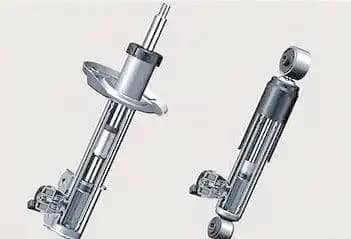
To perform these demanding duties, the design of a heavy-duty shock absorber for a truck is significantly different and more robust than its passenger car counterpart. We at the factory focus on several key engineering aspects:
- Robust Construction: These units are built with larger-diameter cylinders and thicker, more durable materials to withstand extreme heat, pressure, and physical abuse.
- Advanced Hydraulic Fluids: To combat the intense heat generated by heavy use, we use specialized hydraulic fluids with high thermal stability and excellent resistance to aeration.
- Twin-Tube vs. Monotube Design: While twin-tube designs are common and cost-effective for many applications, high-performance and off-road trucks often utilize monotube designs. A monotube shock absorber for a truck, with its pressurized nitrogen charge separating the oil from a gas reservoir, is superior at dissipating heat, preventing performance fade, and maintaining consistent damping characteristics under heavy and sustained loads, which is critical for a true answer to what does a shock absorber do on a truck.
- Specialized Valving: The internal valve systems are meticulously engineered to handle the wide range of motion and forces specific to trucks. They provide the necessary firmness to control heavy loads while still offering compliance over rough terrain.
Section 6: When to Inspect or Replace Shock Absorbers on a Truck
Given their critical role, regular inspection of a truck’s shock absorbers is mandatory for any professional operator. Knowing the signs of failure is key. If you are asking “what does a shock absorber do on a truck?” you should also be asking “how do I know if it’s failing?” The warning signs include:
- Fluid leaks on the shock body.
- Excessive body roll, sway, or “bobbing” (porpoising), especially when carrying a load or towing.
- A noticeable decrease in steering response and control.
- Leaning excessively when cornering.
- A rough, bumpy, or unstable ride, even with no payload.
- Uneven or “cupped” tire wear.
- Trailer sway or instability that was not present before.
When a truck shock absorber fails, it is not an inconvenience; it is a direct threat to safety, and immediate replacement is required.
Conclusion
In conclusion, the answer to the fundamental question, “What does a shock absorber do on a truck?” is one of great responsibility and engineering precision. It is far more than a simple component for a comfortable ride. What does a shock absorber do on a truck? It acts as a sophisticated motion-control system engineered to manage immense kinetic energy. It is a critical guardian of stability, controlling weight transfer to ensure safe braking and cornering. It is the primary line of defense against deadly trailer sway, and it is the key to maintaining control at the interface between a powerful chassis and a heavy trailer. For professionals who rely on their trucks for work, understanding and maintaining a truck’s shock absorber system is not optional—it is an absolute imperative for safe and efficient operation. The shock absorber is an unsung hero that ensures the immense power of a truck is matched by unwavering control.