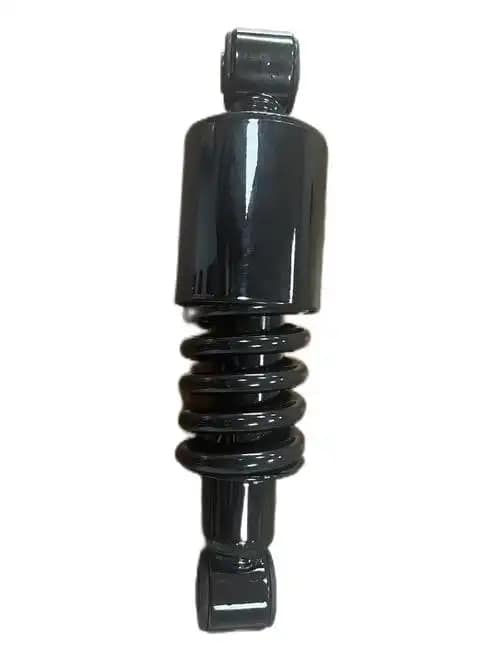
Meta Description: What is a shock absorber? It’s a misunderstood part of your vehicle’s safety system. As expert manufacturers, we define what a shock absorber is, explaining its true function in controlling suspension motion and ensuring tire contact for a safe drive.
Introduction
In the world of automotive maintenance, certain parts have their function perfectly encapsulated in their name: brake pads stop the car, the battery provides power, and the steering wheel directs. Then there is the shock absorber. The name implies a function—absorbing shocks—that is both understandable and entirely incorrect. This fundamental misconception is the root of misunderstanding a component that is critical to vehicle safety, handling, and comfort. So, what is a shock absorber? As a manufacturer who has spent decades perfecting the art and science of hydraulic damping, we are uniquely positioned to answer this question with the clarity and authority it deserves. This guide will move beyond the common myths to provide a definitive, technical explanation of what a shock absorber truly is, its core function, how it interacts with the rest of the vehicle’s suspension, and why understanding its role is essential for every driver.
Core Content
Section 1: The Common Misconception: “Absorbing” is Not Its Job
To understand what a shock absorber is, we must first clear the most pervasive myth surrounding it. The name leads people to believe that its primary job is to absorb the bumps and impacts from the road surface. This is false. The initial impact from a pothole or a speed bump is handled by another, critically important component: the spring.
When a wheel encounters an obstacle, the first line of defense is the suspension spring—be it a coil, leaf, or torsion bar. The spring is designed to be soft and compliant, compressing to absorb the kinetic energy of the impact. If the system were to stop there, the spring would rebound forcefully, launching the wheel and tire back into the air. The result would be a bouncing car with constant loss of tire contact and, consequently, a complete loss of control and traction.
Therefore, the shock absorber is not the first part of the suspension to act. It is, in essence, a motion control device that comes into play after the spring has done its initial job of absorbing impact.
Section 2: The Correct Definition: A Shock Absorber is a Damper
So, if its job isn’t to absorb shocks, what is a shock absorber? The accurate, technical definition is: A velocity-sensitive hydraulic damper.
Let’s break this down. A shock absorber’s primary and singular function is to control or dampen the oscillation of the suspension spring. When the spring compresses and rebounds, it can oscillate for several cycles. A shock absorber acts as a governor, taming this motion and ensuring the spring returns to its rest state as quickly and smoothly as possible. This process is done by converting the kinetic energy of the suspension movement into heat, which is then dissipated into the atmosphere. This is why a shock absorber can become quite hot after spirited driving.
It is its velocity-sensitive nature that makes it so effective. Unlike a simple, fixed-orifice damper, a quality shock absorber is designed to offer different levels of resistance based on how fast the suspension is moving.
- At Low Velocities (e.g., driving over small bumps): The shock absorber offers low resistance, allowing the wheels to follow the road’s contours without jarring the vehicle’s occupants, thereby providing a comfortable ride.
- At High Velocities (e.g., hitting a large pothole or taking a sharp corner): The shock absorber instantly offers high resistance to control the violent and rapid motion of the suspension. This is critical for keeping the tire firmly planted on the ground, maintaining maximum traction, and vehicle stability.
Therefore, what a shock absorber really is, is a damping device. The name “shock absorber” is a holdover from early automotive marketing that has unfortunately stuck, perpetuating a misunderstanding of its true purpose.
Section 3: The Engineering Breakdown: Inside a Shock Absorber
What is a shock absorber, physically? It is a robust, sealed component consisting of a main cylinder filled with a stable, specially formulated hydraulic fluid, a piston rod, and a piston head. Within the piston head lies the magic of velocity-sensitive damping: a series of precisely calibrated and stacked valves (compression and rebound valves).
How it Works:
- The Motion: As the vehicle’s wheel moves up or down relative to the chassis, it pushes or pulls the attached shock absorber‘s piston rod. This causes the piston head to move inside the pressure tube (the main body of the shock).
- Fluid Compression and Decompression: As the piston moves, it takes up space on one side of the cylinder, compressing the fluid and creating a vacuum on the other. To prevent the rod from pulling a vacuum and causing “cavitation” (the formation of destructive air bubbles), fluid must flow from the high-pressure side to the low-pressure side.
- The Valving is Key: This flow does not happen through a simple hole. It must pass through the small orifices in the compression and rebound valves located in the piston head. When the piston moves in one direction (e.g., compression during a bump), it forces fluid through the compression valves. When it reverses (e.g., rebound), fluid is forced through the rebound valves, which are often tuned to provide more resistance than the compression valves to control the spring’s “bounce” more effectively.
- Energy Conversion: The resistance the fluid feels as it is squeezed through these tiny, controlled passages is what creates the damping force. This immense physical friction converts the kinetic energy of the moving suspension into thermal energy (heat). The shock absorber‘s outer body is designed to act as a radiator, dissipating this heat into the air. This process is the very essence of what a shock absorber does.
Section 4: The Critical Connection: How a Shock Absorber Works with the Suspension System
What is a shock absorber’s relationship to the rest of the car? To understand its function, you must see it as a fundamental part of the suspension system. The shock absorber and the spring are a team, and they rely on other components to function correctly.
- The Spring: As discussed, the spring’s job is to hold the vehicle up and absorb the initial impact. Without the spring to first absorb the hit, the shock absorber would be trying to dampen an instantaneous, catastrophic force rather than a controlled oscillation.
- Control Arms & Links: These are the structural links that connect the vehicle’s chassis to the wheel assembly (knuckle). They guide the wheel’s path as it moves up and down, ensuring that the suspension geometry (camber, caster, toe) is maintained for predictable handling and even tire wear.
- Bushings & Joints: These are the pivot points within the suspension system, typically made of rubber or polyurethane. They allow the control arms to move smoothly while isolating the chassis from noise and vibration. Worn bushings can dramatically degrade the effectiveness of the entire suspension system.
Therefore, a shock absorber is not a standalone component. It is a vital piece of the larger suspension system puzzle, working in concert with springs, arms, and bushings to manage forces, control motion, and ensure that the tires remain in constant contact with the road.
Section 5: The Main Types of Shock Absorbers
As manufacturers who produce different products, we understand that what is a shock absorber can vary based on the application. The engineering principles remain the same, but the architectures differ to meet specific performance and cost targets.
- Twin-Tube Shock Absorber: This is the most common design found in standard passenger vehicles. It consists of two nested cylinders: an inner pressure tube that contains the piston and fluid, and an outer reserve tube that holds more fluid and, in gas-charged versions, a low-pressure nitrogen charge. The gas helps prevent the fluid from “foaming” during heavy use, which would cause performance fade. This design prioritizes cost-effectiveness and comfort.
- Monotube Shock Absorber: This is a high-performance design found in sports cars, trucks, and off-road vehicles. It features a single, large-diameter cylinder. Inside, a floating piston separates a high-pressure charge of nitrogen gas from the hydraulic oil. The floating piston acts as a massive heat exchanger, allowing oil to expand and dissipate heat far more efficiently than a twin-tube design. This results in superior resistance to performance fade and more consistent damping under extreme conditions.
- Strut: It’s important to note that a strut is not a different type of shock absorber in the same way that a Twin-Tube is a different type. A strut is an integrated suspension system component that combines the functions of a shock absorber, a spring, a spring seat, and a steering pivot into a single unit. In vehicles with a strut suspension, the shock absorber is simply the damping element housed within this larger structural assembly.
Conclusion
To answer the question, “What is a shock absorber?” with authority, one must move past the name and embrace the engineering. It is not a device for absorbing shocks from the road; that is the spring’s job. A shock absorber is a sophisticated, velocity-sensitive hydraulic damper whose sole purpose is to control the oscillation of the spring. By converting kinetic energy from the suspension’s motion into heat, it ensures that the wheel remains firmly planted on the road, providing the essential functions of safety, stability, and control. It is a critical, yet often overlooked, component of the vehicle’s overall suspension system. Your safety on the road is directly tied to its correct function. Understanding what a shock absorber truly is the first step in appreciating the complex engineering that keeps you safe and in control.