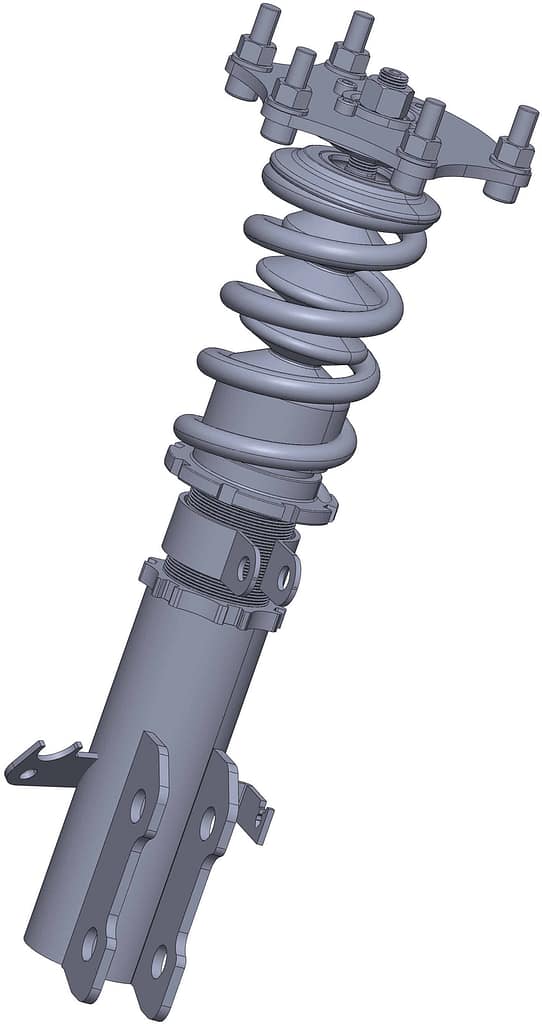
Meta Description: What is a shock absorber? As a manufacturer, we provide a professional, in-depth explanation. Beyond being misunderstood, a shock absorber is a sophisticated velocity-sensitive damper designed to control suspension motion and ensure tire contact for optimal safety and control.
Introduction
In the lexicon of automotive parts, few names are as ubiquitously misunderstood as the “shock absorber.” A common query from vehicle owners, even those who should know better, is, “What is a shock absorber?” The pat, and incorrect, answer is almost always, “It’s the part that smooths out the ride.” While a comfortable ride is a byproduct of its operation, it is not its primary purpose. From the vantage point of our factory floor—where we engineer, forge, and rigorously test these components every single day—we must provide a more accurate, fundamental definition. So, what is a shock absorber? It is a sophisticated, velocity-sensitive damping system. Its true function is to manage the kinetic energy stored and released by the suspension springs, ensuring controlled motion and, most importantly, maintaining uninterrupted contact between the tires and the road surface. This understanding is the key to appreciating its role as a cornerstone of vehicle safety and performance. This article is our definitive guide, designed to answer the question of what is a shock absorber from first principles, moving beyond surface-level assumptions to reveal the engineering and safety science at its core.
Core Content
Section 1: The Fundamental Re-education: Beyond Misconception – What is a Shock Absorber?
To truly grasp what is a shock absorber, we must first address the fundamental misconception embedded in its very name. A shock absorber does not “absorb” a road bump. The component responsible for absorbing the initial impact of an uneven surface is the spring—whether it’s a coil, leaf, or torsion spring. The spring’s job is to flex and compress, cushioning the chassis from the harshness of the road. However, a spring without a control mechanism is dangerously unmanageable. After compressing, it would rebound with significant force, causing the wheel to lift off the road and the vehicle to bounce uncontrollably.
This is the critical moment where the shock absorber’s essential purpose comes into play. What is a shock absorber in this context? It is the motion control device. Its job is to dampen, or resist, the movement of the spring. By doing so, it doesn’t soften the blow; instead, it allows a single, controlled movement. Think of it like this: the spring is the bungee cord, and the shock absorber is the person controlling the descent. Without this control, the jump would be chaotic and uncontrolled. So, the core answer to what is a shock absorber is: it is a velocity-sensitive hydraulic damper designed to control the movement of the suspension, ensuring a stable and controlled response to road inputs, not a cushion for comfort.
Section 2: The Core Purpose: The Ultimate Function of a Shock Absorber
With the misconception clarified, we can delve into the true, safety-critical purpose that defines what is a shock absorber. The ultimate objective of controlling spring motion is to ensure the vehicle’s tires maintain constant and intimate contact with the pavement. The four small, square patches where the tires meet the road are the only points of contact between a vehicle and the physical world. Every action—from braking and accelerating to steering and cornering—depends entirely on the friction generated at these four contact patches. A shock absorber’s most vital job is to preserve this connection.
- What is a Shock Absorber’s Role During Braking? When a driver applies the brakes, a phenomenon known as weight transfer causes the vehicle’s mass to shift violently forward. A healthy shock absorber resists this motion, known as “dive,” keeping the front suspension where it belongs—firmly compressing but not excessively so. This action keeps the front tires on the ground, allowing them to apply their maximum braking potential. A worn shock absorber allows the front end to lunge forward, potentially unloading a front tire and causing a dangerous loss of braking performance.
- What is a Shock Absorber’s Role During Cornering? When navigating a turn, centrifugal force pushes the vehicle’s weight to the outside, causing the chassis to roll or lean. A functioning shock absorber resists this roll, helping to keep the vehicle as flat as possible. Excessive roll caused by a weak shock can cause the inside tires to lose contact, dramatically reducing grip and increasing the risk of a rollover. Understanding what is a shock absorber is vital to understanding that this control of body roll is a safety function, not a performance luxury.
- What is a Shock Absorber’s Role on Uneven Surfaces? Over gravel, potholes, or broken pavement, the wheels move rapidly up and down. The shock absorber’s damping function ensures these movements are controlled, preventing the wheels from bouncing or skipping. This constant tire contact is what allows a driver to maintain steering and throttle control over a rough surface.
Therefore, the most accurate and critical answer to what is a shock absorber is that it is a safety-critical component whose primary function is to control the suspension’s motion to maintain tire contact.
Section 3: The Internal Mechanics – How a Shock Absorber Works
Now that we have established what a shock absorber does, let’s explore how it does it. From a manufacturing standpoint, understanding what is a shock absorber involves appreciating its internal engineering. It is essentially a precision hydraulic pump.
The main components are a cylinder filled with a special hydraulic fluid and a piston attached to a piston rod that travels through the cylinder. As the wheel moves up (compressing the suspension), the piston rod and piston are forced into the cylinder. This action displaces fluid, forcing it through small valves in the piston. As the fluid is forced through these narrow passages, it creates resistance. The same process occurs in reverse when the wheel and piston rod move out (extending the suspension).
The genius of the system lies in the velocity sensitivity. The faster the piston moves (i.e., the faster the wheel is moving up or down), the greater the resistance the fluid creates. This adaptive resistance is precisely calibrated to provide optimal control for every type of road input. It provides just enough resistance to manage the motion without being overly harsh, defining the very essence of what is a shock absorber as a controlled, responsive device.
Section 4: Types of Shock Absorbers: The Evolution of Motion Control
The basic principle of what is a shock absorber has remained constant, but the technology has evolved to meet diverse performance demands.
- Twin-Tube Shocks: This is the most common design for standard passenger cars. It features a two-chamber system: an inner tube where the piston works, and an outer tube that serves as a fluid reservoir. They are reliable and cost-effective. However, they can suffer from aeration (the mixing of fluid with air) under severe use, which can temporarily reduce damping effectiveness.
- Monotube Shocks: This high-performance design consists of a single, pressurized tube, often filled with nitrogen gas in a chamber separated from the oil by a floating piston. This design offers superior heat dissipation and is immune to aeration, providing consistent, fade-free performance. It’s the design of choice for performance cars, heavy-duty trucks, and SUVs.
- Adaptive/Semi-Active Shocks: This is the pinnacle of shock absorber engineering and requires a new definition of what is a shock absorber. Systems like Magnetic Ride Control use a fluid that contains tiny metallic particles. By applying a low-level electrical current to a coil, the viscosity of the fluid can be changed in milliseconds. The car’s computer analyzes road and driving conditions and actively adjusts the shock firmness to match. This allows a vehicle to be plush and comfortable on the highway yet firm and sporty on a winding road in real-time.
Section 5: The Visible Signs of Wear – When a Shock Absorber Fails
Understanding what is a shock absorber is only useful if you can recognize when it’s failing. The degradation is often gradual, making it easy to become accustomed to poorer handling. Key indicators include:
- “Nosing down” when braking or “squating” when accelerating.
- Excessive body roll or sway when cornering.
- The vehicle bouncing more than once after hitting a bump.
- A bouncy or unstable feeling at highway speeds.
- Uneven or cupped tire wear.
- Visible leakage of fluid from the shock body.
When these signs appear, the shock absorber can no longer perform its function, and its replacement is a critical safety issue.
Conclusion
In conclusion, we have returned to the question, what is a shock absorber? Far from being a simple comfort device, we can now define it with precision from a manufacturer’s perspective: it is a sophisticated, velocity-sensitive hydraulic damper whose primary function is to control the unmanaged motion of the suspension springs. This control is fundamentally about safety—it ensures the tires remain in constant contact with the road. This single capability is the bedrock of all vehicle control, from stable braking and predictable cornering to maintaining traction on rough terrain. Therefore, what is a shock absorber? It is an essential and active safety component that works silently to keep the vehicle stable, under control, and firmly connected to the road.