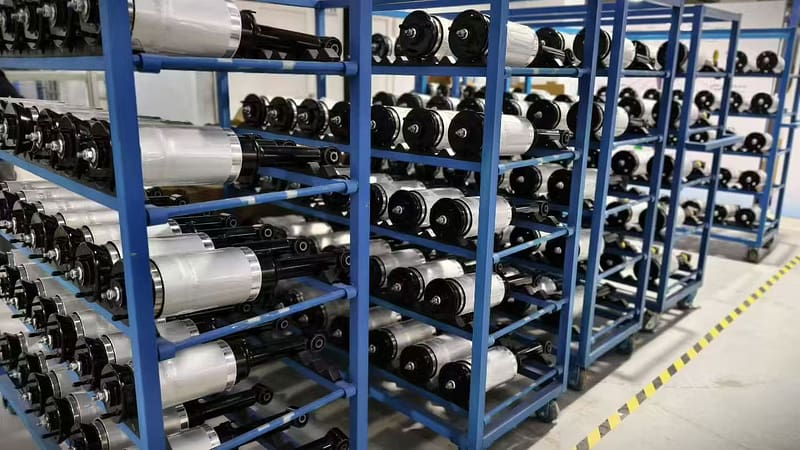
Meta Description: What shock absorbers do is often misunderstood. As a manufacturer, we reveal their true function: they control spring motion to ensure tire contact, guaranteeing safety, stability, and vehicle control. Learn more.
Introduction
From our vantage point on the factory floor, where components are forged, tested, and validated under rigorous, real-world conditions, a fundamental question often arises: “What shock absorbers do?” The common public perception, and a misconception we are dedicated to correcting, is that their primary role is to provide a “smooth ride.” While this is a welcomed byproduct, it is not their core function. A shock absorber is not a comfort device; it is a precision-engineered safety component.
To truly understand what shock absorbers do, we must first reframe the concept. A shock absorber is a velocity-sensitive damping device. Its purpose is not to absorb the jolt from a bump—that is the job of the spring. Instead, it manages the kinetic energy created by the spring’s movement. It prevents the suspension from bouncing uncontrollably, ensuring the tires remain firmly planted on the road. This singular, critical function forms the bedrock of vehicle safety and control. In this definitive guide, written from our perspective as a manufacturer, we will peel back the layers to provide a clear, professional, and authoritative explanation of what shock absorbers do, moving far beyond a simplistic view of ride comfort.
Core Content
Section 1: The Fundamental Misconception Shock Absorbers Don’t Absorb Shocks
The name “shock absorber” itself is a historical misnomer that has perpetuated a common misunderstanding. A more technical and accurate term is “damper” or “shock damper,” as its primary job is to dampen motion, not to absorb impact. Let’s clarify this with a simple analogy. The suspension of a car has two primary parts in this dynamic interaction: the spring and the damper.
- The Spring’s Job: When your wheel hits a bump or pothole, the suspension spring (whether a coil, leaf, or torsion spring) is the first to react. Its job is to absorb the initial force of the impact. It compresses, storing the kinetic energy of the impact and cushioning the chassis from the jolt, thus providing the foundational layer of isolation and “softness.”
- The Shock Absorber’s Job: Once the spring has done its job of compressing and absorbing the initial force, what happens next? If a car only had springs, every time a wheel hit a bump, the spring would rebound, lifting the wheel off the road, causing the car to bounce multiple times. This chaotic, uncontrolled oscillation would make driving impossible and incredibly dangerous. This is precisely where we answer the core question: What shock absorbers do. They are designed to manage this rebound. They apply a controlled, velocity-sensitive resistance to the spring’s energy, forcing it to return to its neutral position in a smooth, controlled manner, rather than allowing it to bounce. They are the “brake” for the suspension’s rebound. This understanding is the cornerstone of comprehending the true purpose of these critical components. It shifts the focus from comfort to safety.
Section 2: The Critical Safety Function: Ensuring Tire-to-Road Contact
The primary function of a shock absorber is direct and unequivocal: it ensures the vehicle’s tires maintain constant and uninterrupted contact with the road surface. This function is the single most important aspect of what shock absorbers do and is the direct reason they are classified as a critical safety component. The four small patches where your tires meet the pavement are the only connection your vehicle has with the world. Every action you ask your car to perform—accelerating, braking, steering—relies entirely on the friction generated at these four contact patches.
- What Shock Absorbers Do During Braking: When you apply the brakes, the vehicle’s weight shifts violently forward due to inertia (weight transfer). This causes the front suspension to compress and the rear to extend (squat). A functioning shock absorber controls this weight transfer. It resists the front from “nose-diving” excessively and controls the rear from squatting too much. This keeps the front tires firmly on the ground for optimal stopping power and maintains stability at the rear. In a car with worn front shocks, the front end can dip so low that a front wheel can lose contact with the road, rendering braking ineffective and potentially causing the driver to lose control.
- What Shock Absorbers Do During Cornering: When navigating a turn, centrifugal force pushes the vehicle’s weight to the outside wheels, causing the car to “body roll.” The shock absorbers, working in concert with the anti-roll bar, resist this rolling motion. This resistance keeps the vehicle flatter in the corner, which is crucial for maintaining tire grip and vehicle stability. With worn shocks, excessive body roll can cause the inside tires to lift, significantly reducing available grip and making a skid or rollover more likely.
- What Shock Absorbers Do on Uneven Surfaces: On gravel or a bumpy road, a shock absorber controls the rapid up-and-down movement of the wheels. This constant control ensures that each tire maintains traction with the ground, allowing the driver to maintain steering and throttle control. Without a shock absorber, the wheels would hop and skip, causing a complete loss of control.
In essence, the primary function of what shock absorbers do is to prevent the moment a tire loses contact with the road. This directly translates into vehicle safety, predictable handling, and accident prevention.
Section 3: The Impact on Handling, Stability, and Ride Quality
Beyond the absolute safety imperative, the functions of shock absorbers extend into the realm of performance and refinement. This is where the perceived “comfort” benefits are better understood.
- Improving Control and Stability: A car with properly functioning shock absorbers feels solid and planted. It responds precisely to steering inputs, accelerates without excessive squat, and brakes without dramatic nosedive. This feeling of “oneness” between the driver and the car is a direct result of controlled suspension motion. A well-damped car feels connected to the road, whereas a car with worn shocks feels “floaty,” “wallowy,” and unstable, which erodes driver confidence.
- Enhancing Ride Quality: A shock absorber contributes to a smooth ride not by softening bumps—again, that’s the spring’s job—but by dampening the high-frequency vibrations that would otherwise be transmitted into the cabin. A worn shock absorber allows a suspension to continue to vibrate, causing a jarring, unsettled ride. By bringing these oscillations to a quick, controlled stop, the shock absorber refines the ride, creating a more comfortable experience without sacrificing control. So, while what shock absorbers do is not to “absorb shocks,” they do significantly contribute to a refined and comfortable ride quality through motion control.
- Protecting Vehicle Components: Every uncontrolled suspension movement puts a stress load on the vehicle’s chassis. By dampening these motions, a healthy set of shock absorbers protects other components, including control arm bushings, ball joints, tie rod ends, and the springs themselves. This protective function is a key reason why we recommend replacing all four shock absorbers at once, as it ensures balanced performance and protects the entire system from uneven wear.
Section 4: The Technology of Damping: Mono-Tube vs. Twin-Tube
To fully appreciate what shock absorbers do, it’s important to understand the technology behind them. From our factory, we produce various types to meet the specific demands of different vehicles and applications.
- Twin-Tube Design: This is the most common design in standard passenger cars. It consists of two cylinders: an outer tube (a reservoir for the hydraulic fluid) and an inner tube, where the piston does its work. They are cost-effective and provide a good balance of comfort and performance. The primary limitation is a tendency for the fluid to aerate (mix with air) under heavy, sustained use, which can lead to a temporary fade in performance.
- Monotube Design: This is a high-performance design favored in sports cars, trucks, and SUVs. It consists of a single, large tube with a floating piston separating the hydraulic oil from a high-pressure nitrogen charge. This design offers several advantages: superior heat dissipation, immunity to aeration, and greater damping force capability. This results in more consistent performance, better resistance to fade, and superior control under demanding conditions.
- Adaptive/Semi-Active Systems: This represents the pinnacle of shock absorber technology. These systems, such as Magnetic Ride Control, use shock absorbers filled with a magneto-rheological fluid—a fluid containing tiny iron particles. By applying an electrical current to a coil around the shock body, the viscosity of the fluid can be changed almost instantaneously. In a semi-active system, the car’s computer continuously analyzes driving conditions and adjusts the shock firmness accordingly. What shock absorbers do in this context is to actively adapt their performance in real-time, delivering a soft, comfortable ride on the highway and a firm, sporty setup on a winding back road.
Section 5: Recognizing When Your Shock Absorbers Are Failing
Knowing what shock absorbers do is only part of the equation. A driver must also recognize the signs when these components are no longer performing their critical functions.
Common symptoms of worn shock absorbers include:
- The vehicle bounces more than once or twice after going over a bump.
- The front end dives excessively during braking, or the rear squats during acceleration.
- The vehicle leans excessively or “rolls” significantly during cornering.
- A general feeling of instability or “wallowing” on the highway.
- Uneven or “cupped” tire wear patterns.
- Leaking fluid visible on the shock absorber body.
These signs indicate that the shock absorber is no longer able to control suspension motion. Since it is a critical safety component, it should be inspected by a qualified technician and replaced promptly. For optimal safety and handling, replacement is almost always recommended in sets of four.
Conclusion
In conclusion, the question “what shock absorbers do?” reveals a component far more sophisticated and critical than its name implies. As a manufacturer, we define it with absolute clarity: a shock absorber is a motion control device, not a comfort device. Its single most important function is to manage the kinetic energy of the suspension springs. By doing so, it ensures the tires maintain constant contact with the road, which is the non-negotiable foundation of vehicle safety. This core function directly translates into shorter stopping distances, predictable handling during cornering, and stable vehicle control in all conditions. Therefore, a shock absorber is a fundamental safety system that deserves the same attention and respect as anti-lock brakes or airbags, for without it, the true safety, control, and performance of a vehicle cannot be guaranteed.